- In response to a case report of repetitive
yawning associated with cardiac
tamponade, I wrote a Readers' Comment titled
"Yawning for an Answer." As a consequence, I
recently received a very interesting and
informative communication from Olivier
Walusinski, who is a world authority on yawning
and author of a book titled "Bâillements
et Pandiculations." He enlightened me on
several aspects of yawning that might be of
interest. Because Walusinski's reports appeared
in noncardiologic publications, cardiologists
might not have seen or read them.
-
- First, yawning is a phylogenetically old,
stereotypical event that occurs in reptiles,
fish, birds, and mammals. Darwin
in his 1838 notebook said "... seeing a dog and
horse and man yawn, makes me feel how much all
animals are built on one structure." Logo's site
shows a kitten yawning, which is not very
different from a human yawning. Incidentally, in
the current concern about a world pandemic of
avian
influenza, yawning in infected flocks is one
of the most sensitive clinical indicators to
detect such an outbreak, with a sensitivity of
100% and a specificity of 79% in turkeys.
-
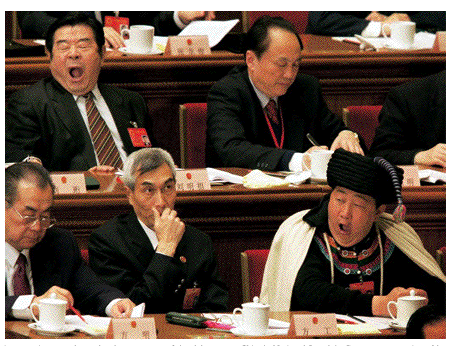
- Second, yawning is contagious. A famous
saying states that a good yawner will induce
yawning in 7 others.7 Ethologic studies of
nonhuman primates have shown that at certain
times an entire group goes about yawning,
without the possibility for 1 member to be aware
of another yawner, whether by sight, hearing, or
smell.7 Although yawning occurs in reptiles,
fish, birds, and mammals,4 yawning replication
is found only in humans.
-
- Third, yawning is a familiar and frequent
occurrence in neonates soon after they are born.
Yawning can even be detected by 4-dimensional
sonography in a fetus. In fact, the lack of
fetal yawning may be a key to predicting brain
stem dysfunction after birth.
-
- Last, but not least, Charles Darwin is said
to have qualified yawning as a piece of useless
physiology. However, from the voluminous data on
the subject (682 citations in a Medline PubMed
very pertinent model allowing for the
understanding of a principle of causality, not
only through ethologic observations, but also
through neurologic determinations regarding
neuroanatomy, on the one hand, and
neurotransmitters and hormones, on the other.
Charcot
(1825-1893) and
Gilles de la Tourette (1857-1904) described
yawning as a clinical sign, long since
forgotten. With the recent search using yawning
as the keyword as report by Krantz et al of
repetitive of yawning is a yawning in a patient
with cardiac tamponade, its importance extends
even into cardiology. For those readers
interested to know more about yawning, there is
a Web site http://yawning.info
with all you want to know about yawning.
-
  -
- 1. Krantz MJ,
Lee JK, Spodick DH. Repetitive yawning
associated with cardiac tamponade. Am J Cardiol
2004;94:701-702.
-
- 2. Cheng TO. Yawning for an answer. Am J
Cardiol 2005;95:437.
-
- 3. Walusinski
O. Bâillements et Pandiculations:
Etiologie, Neurophysiologie, Pathologie. Brou,
France: Oscitatio Editeur, 2004: 1-200.
-
- 4. Walusinki
O, Kurjak A, Andonotopo W, Azumendi G. Fetal
yawning assessed by 3D and 4D sonography.
Ultrasound Rev Obstet Gynecol
2005;5:210-217.
-
- 5. Smith EO.
Yawning: an evolutionary perspective. Hum Evol
1999;14(3):191-198.
-
- 6. Elbers
AR, Koch G, Bouma A. Performance of clinical
signs in poultry for the detection of outbreaks
during the avian influenza A (117N7) epidemic in
The Netherlands in 2003. Avian Pathol
2(X)5;34:181-187.
-
- 7. Walusinski
O, Deputte BL. Le bâillement:
phylogenèse, éthologie,
nosogénie. Rev Neurol
2004;160:1011-1021.
-
- 8. Provine
RR. Yawning. American Scientist
2005;93:532-539.
-
- 9. Deputte
BL, Johnson J, Hempel M, Scheffler G.
Behavioral effects of an antiandrogen in adult
male rhesus macaques (Macaca mulatta). Horm
Behav 1994;28:155-164.
-
- 10. Provine
RR. Contagious yawning and infant imitation.
Bull Psychonomic Soc 1989;27:125126.
-
- 11. Provine
RR. Faces as releasers of contagious
yawning: on approach to face detection using
normal human subjects. Bull Psychonoinic Soc
1989;27:211-214.
|

