Résumé : Certains cas
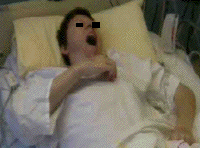
d'hémiplégies associent
l'élévation involontaire du bras
paralysé au déroulement du
bâillement, ce que nous avons
baptisé « parakinésie
brachiale oscitante ». C'est un
phénomène curieux, reconnu depuis
plus de 150 ans, apparaîssant rare parce
que, sans doute, le plus souvent
négligé. Quatre observations ont
été recueillies dans le service de
neurologie du CHU de Poitiers. Leur description
détaillée est rapportée.
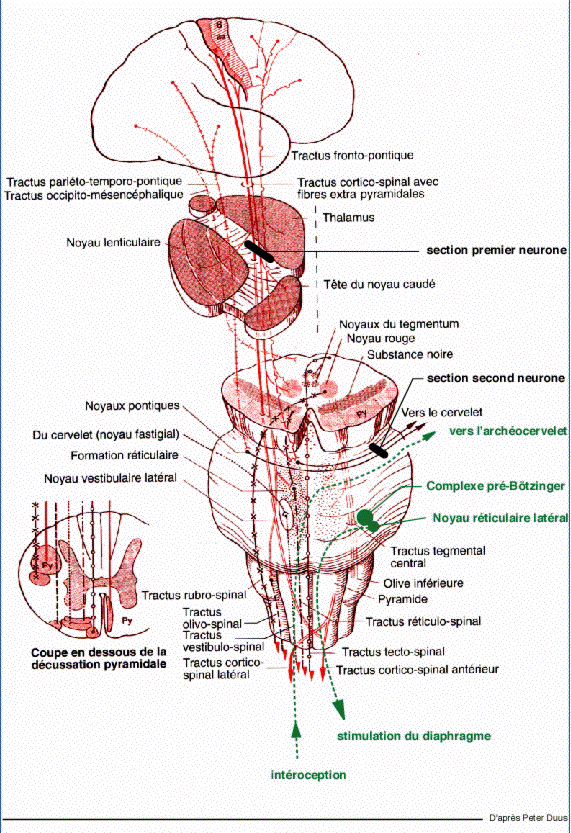
Une explication physiopathologique est
avancée. La levée du
contrôle cortical permet à des
structures sous-corticales,
phylogénétiquement plus anciennes,
de retrouver une autonomie au cours d'un
processus d'homéostasie associant la
stimulation de la vigilance au contrôle de
la ventilation. Ce mouvement ventilatoire est
couplé à la motricité chez
les quadrupèdes. Ainsi ressurgit lors du
cycle ventilatoire du bâillement un
automatisme du bras, comparable au balancement
de celui-ci lors de la marche.
Abtract : In some cases of hemiplegia
the onset of yawning is associated with an
involuntary raising of the paralysed arm. For
this phenomenon we coined the term «
parakinesia brachialis oscitans ».
This curious phenomenon, that was first
described some 150 years ago, is seldom
reported, probably because it is mostly
neglected. Four observations have been made in
the neurology unit of the (University) Hospital
of Poitiers. A detailed description of these
cases is reported and a physiopathologic
explanation is proposed. The cessation of
cortical inhibition allows some subcortical
structures, which are phylogenetically more
ancient, to regain autonomy in the homeostasis
process, which associates the stimulation of
vigilance with breathing control. In quadrupeds
breathing is linked intimately with locomotion
(walking). Thus, during the onset of yawning (as
a special type of breathing) the paralysed arm
automatically starts moving as in the balancing
act of walking.
Abercrombie
J, Gendrin A Des maladies de
l'encéphale et de la moelle
épinière Germer-Baillière
1835
Abercrombie
J Yawning and apoplexy Medical Times and
Gazette 1863;1:656-661
Bauer G. et al
Involuntary motor phenomena in the locked in
syndrome J Neurology 1980;223;:91-198
Bertolotti
M. Etude sur la pandiculation automatique
des hémiplégiques Rev Neurol
1905;2(19): 953-959
de
Buck Classification des mouvements anormaux
associés à
l'hémiplégie Rev Neurol
1899;6:361-365
Furtado D.
Provocation spinale d'un réflexe de
bâillement. Rev d'oto neuro
ophtalmologie.1951;23(1):
Ghika
J., Bogousslavsky J. Dissociated
preservation of automatic-voluntary jaw
movements in a patient with biopercular and
unilateral pontine infarcts Eur Neurol
2003;50:185-188
Heusner A P
Yawning and associated phenomena Physiological
Review 1946;25:156-168
Lanari A.,
Delbono O. The yawning and stretching sign
in hemiplegics Medicina (B Aires)
1983;43(3):355-35
Liecey Nouvelle
observation de bâillement convulsif
périodique Le Courrier Médical
1879;29;334-336
Liégey Deux
observations de bâillements intermittents
Gazette médicale de Strasbourg 1851;
p118-119
Louwerse E
Forced yawning as a pseudobulbar sign in
amyotrophic lateral sclerosis J Neuroscience
Research 1998, sup, 392
Mulley G.
Assoctiated reactions in the hemiplegic arm
Scand J Rehab Med 1982;14:117-120
Ogle
JW. Arm rising during yawning The Medical
Times and Gazette. 28 february 1863 p 213
Pierre
Marie La Pratique Neurologique
Hémiplégie, mouvements
associés Masson 1911, p477-480
Pierre
Marie et Léri A. Mouvements
involontaires dans les membres paralysés
1911 Nouveau Traité de médecine et
de thérapeutique Brouardel, Gilbert,
Thoinot JB Baillière Ed 1911
p283-291
Quoirin E.
Elévation involontaire du membre
supérieur chez
l'hémiplégique lors d'un
bâillement Thèse doctorat en
médecine Poitiers 2002
Thomson HC
Associated movements in hemiplegia : their
origin and physiological significance Brain
1903;26:515-523
Töpper
R, Mull M, Nacimento W Involuntary
stretching during yawning in patients with
pyramidal tract lesions: further evidence for
the existence of an independent emotional motor
system European J Neurology 2003;10:495-499
Trautmann R. Le
bâillement Thèse Bordeaux; 1901-02;
N° 40; 86 pages
Vulpian
A Leçons sur la physiologie
générale et comparée du
système nerveux faites au Museum
d'histoire naturelle. Rédigées par
E.Brémond. Paris, Baillière,
1866
Vulpian
A Maladies du système nerveux Paris,
Doin, 1879
Walshe FMR
On certain tonic or postural reflexes in
hemiplegia with special reference to the so
called "associated movements". Brain,
1923;46:1-37
Wimalaratna HS,
Capildeo R. Is yawning a brainstem
phenomenon ? a stroke patient who stretched his
hemiplegic arm during yawning Lancet
1988;1(8580):300