Descriptions of neonatatal behavior and
studies on the ontogeny and organization of
sleep have shown that infants exhibit several
discrete and cyclic patterns of sleep and
wakefulness called states. Other studies have
shown that changes in physiologic variables such
as heart rate, minute ventilation, oxygen
consumption, transcutantous PO2, and cerebral
blood flow accompany changes in state. These
findings suggest that the results of physiologic
research in newborn infants may be
misinterpreted if the effects of an infant's
state are not taken into account.
States are usually designated by observing
recurring patterns of an infant's behavior, the
EEG, and certain physiologic variables. Although
guidelines for coding states of sleep and
wakefulness of term infants have become widely
accepted, no comparable guidelines exist for
preterm infants whose behavioral, neuroelectric,
and physiologic patterns are less discrete and
less consistently interrelated. Furthermore, the
primary focus of most scoring systems is on
infant sleep per se, and these systems are net
always conveniently applicable te other areas of
neonatal research.
The purpose of this paper is to explain the
design and validation of a simple, practical,
and reliable system for determining the state of
sleep or wakefulness in both term and preterm
infants. Experience with this system indicates
that it is a useful tool for relating state of
sleep and wakefulness to physiologic variables
during experimental studies of newborn
infants.
DESCRIPTION OF THE SYSTEM
The scoring system, is based on independent
assessments of behavioral and EEG patterns.
Behavioral observations include the quality of
body and eye movements. Code numbers are
assigned te the behavioral and EEG patterns
according to the systems given below.
Designation of the infant's state of sleep or
wakefulness is then made by combining concurrent
behavioral and EEG scores into a single two
number code. Because many physiologic variables
are conventionally measured on a
minute-by-minute basis, the epoch length for
coding state with this system is 1 mn.
Coding of behavior. The following
system for coding infant behavior is
bàsèd upon observations made in
our laboratory and by others.
Pattern 1. Eyes closed with
predominantly flaccid "rag doll" appearance.
Body movements are limited to startles (sudden
contractions of many muscles lasting a few
seconds with an immediate return to a relaxed
posture). Occasionally increased muscle tone
reflected in antigravity posturing of the
extremities is observed. Rhythmicj aw jerks
lasting 1 to 2 sec are also seen.
Pattern 2. Small body movements are
seen. Motor activity includes slow intermittent
writhing movements, jerky startles, small
movements of an extremity or its parts, frowns,
smiles, chewing and sucking movements, grimaces,
and other facial activity, grunts, and
occasional whimpers.
Pattern 3. REMs observed. Body
movements are limited to those seen in Patterns
1 and 2. Eyes may occasionally open and close or
remain briefly half-open.
Pattern 4. Wakeful behavior. Apparent
nonreflex movements of limbs with prolonged
startles and gross stretching and writhing. The
infant may be intermittently motionless and
appear alert. Facial activity is usually
prescrit and the eyes may be open or closed. No
crying is observed.
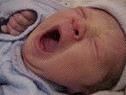
Pattern 5. Crying. The features of
Pattern 4 are also observed.
Pattern 6. Recovery period after
crying. Deep rapid respirations are prominent
with little extremity movement. Eyes are usually
closed.
Recording and coding the EEG. Widely
accepted guidelines for recording the EEG have
been published. We record the EEG, EOG, ECG, and
other physiologic measurements on a Grass Model
6 16-channel EEG. A minimum of two EEG channels
is recorded (C4-O2 and C4-A1), and EEG scoring
is performed retrospectively. We extended the
system widely used for coding EEGs of term
infants so that it could be applied to preterm
infants as well. When two or more patterns are
observed in a single epoch, the pattern that
predominates is assigned to the epoch.
Pattern 1. Trace alternant. Bursts of
50- 100 µV slow waves (0.53 Hz) with
occasional superimposition of rapid low voltage
waves. These bursts, lasting 3-8 sec, are
separated by 4-8 sec of low voltage or mixed
activity. or . Tracé discontinu. Bursts
of high voltage (>100 µV) 0.5-2 Hz waves
lasting 3-10 sec, separated by periods of
attenuated activity (typically less than 5
µV) lasting 10-40 sec.
Pattern 2. High voltage slow.
Continuous medium to high voltage activity
(mostly 75 µV, occasionally 100-150
µV) comprised of frequencies of 0.5-4 Hz.
The slow waves are often rhythmic.
Pattern 3. Mixed. Predominantly
continuous polymorphic activity of 4-7 Hz,
averaging 50 µV in amplitude, intermingled
with slower waves (2-4 Hz) of slightly higher
voltage.
Pattern 4. Immature rhythmic slowing.
Monomorphic high voltage (>100 µV) waves
of 0.3-2 Hz which often occur in extended
sequences lasting longer than 10 sec. They are
particularly prominent over the temporal and
occipital areas and are often associated with
superimposed 10-20 Hz activity ("brushes").
Other activity includes moderate voltage 2-8 Hz
waveforms.
Pattern 5. Low voltage. Continuous
4-7 Hz activity, sometimes rhythmic, with
voltages predominantly 20-30 µV.
Artifact time, a minute of poor quality that
is uninterpretable due to excessive muscle
activity, crying, or handling, is coded.
[...]
DISCUSSION
For purposes of physiologic investigation,
this scoring system has several important
advantages. First, it may be applied to preterm
as well as term infants, thus allowing the
investigator to code sleep and wakefulness in a
consistent, practical way while following
developmental changes in physiology. Second, it
uses a simplified scheme aflowing important
behavioral and neurophysiologic criteria to be
grouped so that designation of sleep and
wakefulness is expressed by a 2-number code. In
addition, the system retains its usefulness when
epoch lengths other than 1 min are desired. For
example, we bave successfülly applied the
system in analyzing 3-min values of heart rate,
minute ventilation, and oxygen consumption.
The designation of state with separate
scores for behavioral and EEG patterns preserves
valuable information, especially regarding
indeterminate sleep. For example, an infant with
REMs who shows EEG criteria of quiet sleep wouId
be scored EEG 1, B3. Similarly, constant small
body movements without REMs but with a
discontinuous EEG would be registered EEG 1,
B2.
The criteria selected to define individual
behavioral and EEG patterns are based on
extensive observations in our nursery as well as
on the work of others. Chin myogram and the
rates and variabilities of pulse and respiration
are excluded. The chin myogram is highly
variable, particularly in preterm infants and,
therefore, is not consistently applicable as a
criterion for state designation. Heart rate and
respiration are excluded because they are often
dependent variables in physiologic studies.
These variables require a framework for
interpretation that does not presuppose their
occurrence in a particular state of sleep or
wakefulness.
Selection and grouping of criteria is, to a
certain degree, arbitrary in any system of state
assignment, and the designation of an infant's
state will sometimes differ according to the
system used. Monod and Guidasci coded records of
10 normal terrn neonates according to four
different systems and found large discrepancies,
particularly in the distribution of active and
indeterminate sleep. Parmelee et al. coded
records of both term and preterm, infants
according to two different methods and found
similar discrepancies. The present system
produces rends in the distribution of sleep and
wakefulness within the range of previous
findings.
No consensus exists that it is possible or
advisable to determine states in preterm
infants. We emphasize, however, that physioogic
measurements that do not control for state
variability are often misleading; thus,
physiologic studies of preterm infants cannot
proceed optimally without a system for the
designation of state. Results of validation
studies with the present system how that good
agreement between observers exists in recognizng
behavioral and EEG patterns in both term and
preterm nfants. Our data indicate that the
criteria of body movements, eye movements, and
EEG activity are in fact as applicable to the
designation of states in preterin infants as in
term subjects.
Furthermore, studies using this scoring
system show that consistent changes in multiple
physiologic measurements accompany changes in
state. Use by other investigators is needed to
confirm the practicality and reliability of the
system.
Sleep-wake
states and their regulatory mechanisms
throughout early human
development
Peirano P, Algarin C, Uauy R
Journal Of Pediatrics 2003;
143; 4S; S70-9
The emergence of sleep states is one of the
most significant aspects of development.
Descriptions of both neonatal and late fetal
behavior and studies on the organization of
sleep have shown that fetus and newborns exhibit
spontaneously discrete and cyclic patterns of
active sleep (AS) and quiet sleep (QS).
Human fetuses and neonates sleep most of
their life, and AS is the prevailing state even
during the first postnatal months. Several
hypotheses to explain central nervous system
development consider that AS is the expression
of a basic activation program for the central
nervous system that increases the functional
competence of neurons, circuits, and complex
patterns before the organism is called on to use
them.
Current results indicate the maturation of
QS not only coincides with the formation of
thalamocortical and intracortical patterns of
innervation and periods of heightened
synaptogenesis, since this sleep state is also
associated with important processes in synaptic
remodeling. In fact, several studies suggest
that the information acquired during wakefulness
is further processed during AS and QS.
This article reviews the processes involved
in the timing of both AS/QS and sleep/wake
alternating patterns throughout early human
development. A growing body of evidence
indicates that the duration of unmodulated
parental care and noncircadian environmental
conditions may be detrimental for the
establishment of these basic rhythmicities. As a
consequence, alterations in
parental/environmental entraining factors may
well contribute to disturb sleep and feeding
commonly experienced by preterm infants. Further
knowledge on the early establishment of
sleep-wake states regulatory mechanisms is
needed to improve modalities for appropriate
stimulation in the developing human being.