ABSTRACT: Six adult female
chimpanzees were shown video scenes of
chimpanzees repeatedly yawning or of chimpanzees
showing open-mouth facial expressions that were
not yawns. Two out of the six females showed
significantly higher frequencies of yawning in
response to yawn videos; no chimpanzees showed
the inverse. Three infant chimpanzees that
accompanied their mothers did not yawn at all.
These data are highly reminiscent of the
contagious yawning effects reported for humans.
Contagious yawning is thought to be based on the
capacity for empathy. Contagious yawning in
chimpanzees provides further evidence that these
apes may possess advanced self-awareness and
empathic abilities.
Experimental evidence supports the common
observation that seeing other people yawn can
induce yawning (Provine 1986, 1989; Platek et
al. 2003). Studies have shown that between 42%
and 55% of human adults will yawn during, or
shortly after, seeing a videotape of repeated
yawns of other humans. The only systematic study
to our knowledge of children, however, found
that children aged younger than 5 years do not
show this contagious yawning effect (Anderson
& Meno 2003).
Although yawning is widespread among
vertebrate species, contagious yawning has been
reported only in humans (Lehmann 1979;
Baenninger 1987; Smith 1999). It has been
suggested that contagious yawning reflects a
basic capacity for empathy (Lehmann 1979), and a
recent study linked human individual differences
in susceptibility to contagious yawning to
differences in empathic tendencies,
self-recognition ability and theory of mind
(Platek et al. 2003). We assessed whether
chimpanzeesÑhumans' nearest phylogenetic
neighboursÑare prone to contagious
yawning when exposed to videotapes showing
yawning of conspecifics. Evidence of contagious
yawning would provide further evidence of
similarities in the evolution of selfand
other-awareness between great apes and
humans.
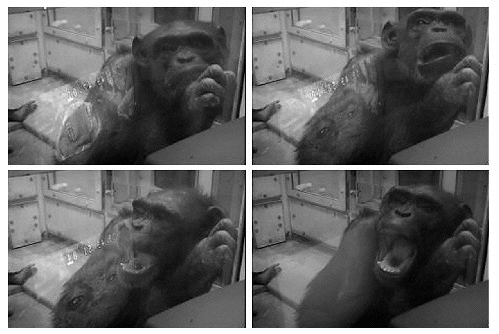
A yawn response during presentation
of a yawn videotape. Ai watches a yawn on the
screen (top left), starts to yawn as the
stimulus yawn ends (top right), continues to
yawn (bottom left), and completes the yawn while
the screen is blank (bottom right) See
the video
MATERIAL AND METHODS
(a) Subjects :We
tested six socially reared, group-living adult
female chimpanzees (Pan troglodytes) living at
the Primate Research Institute of Kyoto
University. They were individually invited to
leave their outdoor enclosure and enter a
familiar test booth; three of them brought their
3-year-old dependent infants with them. The
chimpanzees had extensive experience with
experiments on learning and cognition (Matsuzawa
1985, 2003; Kawai & Matsuzawa 2000; Morimura
& Matsuzawa 2001), but none had previously
observed video stimuli of the type used here.
This experimental work complied with the Guide
for the Care and Use of Laboratory Primates,
Primate Research Institute, Kyoto
University.
(b) Experimental apparatus
:We prepared two 'yawn' and two
'open-mouthed' videotapes. Yawn videos contained
10 naturally occurring yawns by chimpanzees,
each separated by 6Ð10 s of a blue, blank
screen (see figure 1 or an example).
Open-mouthed videos were equated for total
duration, and showed chimpanzees displaying
eight or ten openmouthed faces but not yawning
(for example, while pant-hooting or grinning),
again separated by a blank screen. The videos
displayed chimpanzees in various postures and
orientations, the most salient feature being the
yawns or open-mouthed expressions. One yawn
video presented yawns by familiar chimpanzees
from the subjects' own group, and the other
presented yawns by unfamiliar chimpanzees in the
wild. The videos were shown silently on a 35 cm
monitor (Panasonic TH-14RF2) positioned on a
small table 30 cm high and ca. 8 cm from the
front of the glass-walled booth.
(c) Experimental procedure
:Two videotapes were shown in
each session. Five minutes after the chimpanzee
entered the booth, the monitor was switched on
and the first video ran until completion of the
last yawn or open-mouth (3 min). The monitor was
then switched off and the chimpanzee was
observed for 3 min. A 5-min distraction period
then followed, after which the second video was
shown (3 min), followed by another 3- min
observation period. Each chimpanzee was tested
during four sessions, with the following order
of video combinations presented in each session:
(i) familiar yawn, unfamiliar open-mouth; (ii)
unfamiliar open-mouth, familiar yawn; (iii)
familiar open-mouth, unfamiliar yawn; (iv)
unfamiliar yawn, familiar open-mouth. All
sessions were videotaped through the glass walls
of the booth, using three fixedposition cameras,
two of which were operated manually. The three
authors were present but remained passive
throughout, except that T.M. occasionally
encouraged the chimpanzee to watch the monitor
if her attention appeared to wane. All yawns by
the subject chimpanzees were scored in real time
and then verified by subsequent video analysis;
agreement between the three authors was
100%.
RESULTS
The adult chimpanzees yawned, on average,
4.7 times during and after the open-mouth
videos, and this rose to 10 yawns during and
after the yawn videos. The data were analysed
both at the group level and individual level.
There were no significant effects at group
level, as assessed by paired t-tests. However,
two chimpanzees (Ai, Mari) showed significantly
higher frequencies of yawning during or shortly
after exposure to yawn videos (totals: 24 and
25) than to open-mouth videos (2 and 9; both p
0.01, binomial tests). Figure 1 shows a
chimpanzee yawning during exposure to a yawn
video, and figure 2 presents the data for all of
the adult chimpanzees. Social familiarity of the
chimpanzees in the videos did not affect yawning
frequency. No chimpanzee showed significantly
more yawning in response to the open-mouth
videos, and open-mouth videos did not elicit
facial expressions. None of the three infant
chimpanzees yawned at any time during the
tests.
DISCUSSION
Higher frequencies of yawning in response to
yawn stimuli compared with the open-mouth
control stimuli indicate a contagion effect in
33% of the adult chimpanzees. This percentage is
only slightly lower than the percentages
reported for adult humans exposed to visual yawn
stimuli (Provine 1986; Platek et al. 2003). It
can be argued that the percentage of chimpanzees
showing contagious yawning is even more
impressive, given that adult human participants
are usually aware of the phenomenon being
studied, and simply thinking about yawning may
induce yawns (Provine 1989). The chimpanzees had
no knowledge of what the experimenters were
interested in, and had no idea of what was
expected of them. Unlike Old World monkeys
(Deputte 1994), chimpanzees do not appear to
show a sex difference in their frequency of
yawning. None of the infant chimpanzees that
accompanied their mothers showed any yawning,
even though they watched the videos and saw
their mothers yawning.
This absence of contagious yawning in infant
chimpanzees recalls the absence of contagious
yawning in human toddlers reported by Anderson
& Meno (2003). Further work on the young
chimpanzees will clarify the extent to which
contagious yawning in chimpanzees resembles the
same behaviour in humans. Chimpanzees display
self-recognition in mirrors (Gallup 1970;
Povinelli et al. 1997), a sign of objective
self-awareness that has been linked with the
capacity for empathy (Gallup 1982). Monkeys do
not show self-recognition (Anderson 1994), and
observations of social behaviour reveal much
more convincing evidence of empathy in
chimpanzees than in monkeys (de Waal 1996).
Observational studies of spontaneous yawning in
monkeys indicate that it is not contagious
(Baenninger 1987; Deputte 1994). Given the
distribution of self-recognition and social
cognitive abilities among primates, we predict
that susceptibility to contagious yawning will
be found in other great apes, but not monkeys,
and that individual differences in
susceptibility to contagious yawning may be
related to differences in self-recognition and
empathy.
Anderson, J. R. 1994 The monkey in the
mirror: a strange conspecific. In Self-awareness
in animals and humans: developmental
perspectives (ed. S. T. Parker, R. W. Mitchell
& M. L. Boccia), pp. 315-329. New York:
Cambridge University Press.
Anderson
JR; Wunderlich D Food-reinforced yawning in
Macaca tonkeana American Journal of Primatology
1988; 16; 165-169
Paukner
A, Anderson JR Video-induced yawning in
stumptail macaques (Macaca arctoides) Biol Lett
2006; 2; 36-38
Baenninger,
R. 1987 Some comparative aspects of yawning
in Betta splendens, Homo sapiens, Panthera leo
and Papio sphinx. J. Comp. Psychol. 101,
349-354.
Deputte, B.
L. 1994 Ethological study of yawning in
primates. I. Quantitative analysis and study of
causation in two species of Old World monkeys
(Cercocebus albigena and Macaca fascicularis).
Ethology 98, 221-245.
de Waal, F. 1996 Good natured: the origins
of right and wrong in humans and other animals.
Cambridge, MA: Harvard University Press.
Gallup Jr, G. G. 1970 Chimpanzees:
self-recognition. Science 167, 86-87.
Gallup Jr, G. G. 1982 Self-awareness and the
emergence of mind in primates. Am. J. Primatol.
2, 237-248.
Kawai, N. & Matsuzawa, T. 2000 Numerical
memory span in a chimpanzee. Nature 403,
39-40.
Lehmann, H. E.
1979 Yawning: a homeostatic reflex and its
psychological significance. Bull. Meninger Clin.
43, 123-136.
Matsuzawa, T. 1985 Use of numbers by a
chimpanzee. Nature 315, 57-59.
Matsuzawa, T. 2003 The Ai project:
historical and ecological contexts.Anim. Cogn 6,
199-211.
Morimura, N. & Matsuzawa, T. 2001 Memory
of movies by chimpanzees (Pan troglodytes). J.
Comp. Psychol. 115, 152-158.
Povinelli, D. J., Gallup Jr, G. G., Eddy, T.
J., Bierschwale, D. T., Engstrom, M. C.,
Perilloux, H. K. & Toxopeus, I. B. 1997
Chimpanzees recognize themselves in mirrors.
Anim. Behav. 53, 1083-1088.
Provine, R.
R. 1986 Yawning as a stereotyped action
patterns and releasing stimulus. Ethology 72,
448-455.
Provine, R.
R. 1989 Faces as releasers of contagious
yawning: an approach to face detection using
normal human subjects. Bull. Psychon. Soc. 27,
211-214.
Smith, E. O.
1999 Yawning: an evolutionary perspective. Hum.
Evol. 14, 191-198