Instituto
de Fisiología, Benemérita
Universidad Autónoma de Puebla,
Puebla, México
Yawning is a common
behavioral event that is observed in humans,
as well as other mammals, birds, and
reptiles. In humans, yawning often occurs
just before bed and upon waking up, and is
also associated with tedious or boring
situations. Although the physiologic roles of
yawning have yet to be fully elucidated, the
past 50 years of research has led to a much
greater understanding of the
neuropharmacologic regulation of yawning.
While many of the early studies concluded
that yawning was primarily driven by changes
in cholinergic neurotransmission, we now know
that numerous neurotransmitters and
neurohormones are involved in the mediation
of yawning, including acetylcholine,
dopamine, glutamate, serotonin, oxytocin,
GABA, opioids, adrenergics, nitric oxide, as
well as the POMC-derived peptides ACTH and
a-MSH. Furthermore, antagonist interaction
studies have clearly defined at least three
distinct neural pathways involved in the
induction of yawning, as well as the
hierarchical order through which these
different neurotransmitter systems interact
to regulate yawning. The following sections
will discuss the state of knowledge for each
of the major neurotransmitters and
neurohormones involved in the regulation of
yawning, their interactions with one another,
and their place in the hierarchical
organization of yawning.
The involvement of the dopaminergic
system can be evidenced through the
administration of small doses of apomorphine,
a mixted agonist of the D1-D2 receptors of
dopaminergic synapses which induces yawning.
Strong doses make them disappear and cause
motor stereotypies in animals or dyskenesias
of the face in human. Such yawns induced by
apomorphine are antagonised by typical and
atypical neuroleptics, but not by
domperidone, a blocking agent of peripheral
dopaminergic receptors because it cannot
cross the blood-brain barrier. The
disappearance of yawning in extrapyramical
syndromes confirms the importance of the
dopaminergic pathway. The correlate is that
giving an injection of apomorphine to a
parkinsonian triggers, during the next ten
minutes, a yawn a minute, with a repeat cycle
at the end of the test one hour later.
Similarly, a parkinsonian who loosens up
under the effet of L-DOPA yawns when this
occurs.
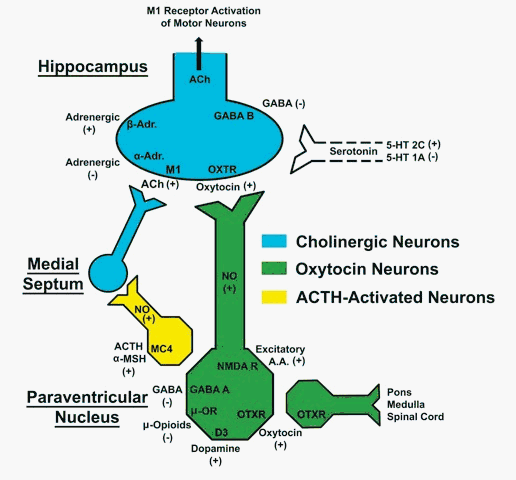
Endogenous peptide system :
Hypophysectomy prevents yawning from
happening. ACTH, MSH (melanocyte-stimulating
hormone), LH-RH, all hypophysial peptides
administered to rats by intrathecal
injection, induce yawns and an erection.
Ocytocine injected in the paraventricular
nucleus of the hypothalamus (its destruction
prevents any yawning) triggers yawns, while
an ocytocine inhibitor prevents them. The
role of the paraventricular nucleus of the
hypothalamus and of the pituitary gland is
controlled by an ocytocinergic network which
receives dopaminergic activating influences
and opioid inhibiting influences. This
network reaches the hippocampus, on one hand,
and the bulbopontine region (the one that
probably commands yawning), on the other
hand. At the level of the hypothalamic
nucleus one finds a parallel between the
activation or not of yawning and the presence
or not of nitric oxide synthetase (NO).
The serotoninergic influence has
been demonstrated by various pharmacological
experiments. For instance, mCPP
(1-3-chlorophenyl-piperazine) which is
selective for 5-HT2c receptors is a powerful
inducer of yawns in Man as well as animals.
This probably explains the iatrogenic effect
of yawn salvos in patients receiving
serotoninergic antagonists such as
antidepressants (serotonine reuptake
inhibiting action). On the other hand, the
stimulation of 5-HT1a and 5-HT2 receptors
prevents the development of yawns induced by
apomorphine, as well as by mCPP or
nitric-acid inhibitors. The paraventricular
nucleus of the hypothalamus, which receives
major serotoninergic projections originating
in the nucleus of the dorsal raphe, would be
the seat of a modulation of dopaminergic and
ocytocinergic neurons by the serotocinergic
receptors of these neurons.
There is probably a final cholinergic
pathway because pilocarpine and
physostigmine, muscarinic agonists
(acethylcholinesterase inhibiting) are
powerful yawn triggers that are inhibited by
atropine or scopolamine, acting as
antagonists. These experiments show that the
cholinergic pathways are the terminal, or
executive, link common to all mechanisms
triggering pharmacologically induced
yawns.
Role of sexual hormones : in
castrated rats, the response to apomorphine
or ocytocine disappears. An injection of
testosterone restores erection, but it must
be accompanied by injections of estradiol for
the yawn-erection diptych to occur.
Tamoxifen, an anti-estrogen, prevents the
reoccurrence of yawns induced by apomorphine
after a testosterone-estradiol treatment. In
non-castrated rats, progesterone increases
and estradiol inhibits yawns triggered by
apomorphine, without impact on erection.
However, tamoxifen prevents inhibition of
this type of yawn by estradiol. Because of
their structure, steroids offer an activation
mechanism that differs from that of the other
major hormones. Some hormones, such as
ocytocine, are proteins that act on membrane
receptors located outside the cell and cannot
penetrate the double lipid layer of which
cell membranes are made. But, steroidian
hormones, given their lipid nature, cross the
cell wall and act on the intracytoplasmic
receptors, which gives them direct access to
the nucleus and the regulation of genic
expression. Differences in the concentration
of these receptors in various cerebral
regions are responsible for the differential
action of these hormones. It also appears
that these hormones act by modifying the
microsomial metabolism of neurotransmitters.
The facilitating effect of
dihydro-testosterone on yawning would
intervene at the cholinergic and
serotoninergic level. There is as yet no
proposed explanation regarding the reason for
the disappearance of this phenomenon in human
primates.
-Sanna
F, Succu S, Melis MR, Argiolas A.
Dopamine agonist-induced penile erection and
yawning: Differential role of D(2)-like
receptor subtypes and correlation with nitric
oxide production in the paraventricular
nucleus of the hypothalamus of male rats.
Behav Brain Res. 2012