- Charles Foix was born in
Salies-de-Béarn, near Bayonne, in
south-western France. The son of a physician, he
studied medicine at the University of Paris and
was a pupil of Pierre
Marie (1853-1940) at the
Salpêtrière. He was an intern in
1906, Médecin des hôpitaux in 1919
and became agrégé in 1923.
-
- A most impressive teacher and clinician,
Foix was almost as much at home with general
medicine as he was with neurology, and during
the ist World War was put in charge of a
tuberculosis service. From 1921 he worked at a
tuberculosis ward in the Bicêtre. When the
time came for his inaugural lecture, he was
given four hours in which to prepare a discourse
on the splenic anaemias, and did so brilliantly.
From 1923 he worked in the Hôpital
Ivry.
-
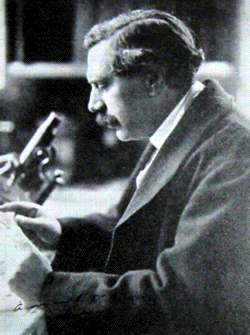 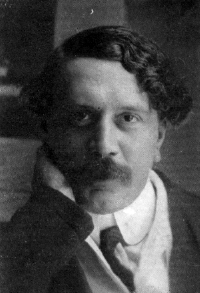 -
- Foix taught at Georges
Charles Guillain's (1876-1961) clinic at the
Salpêtrière and at Emile Charles
Achard's (1860-1944) at the Hôpital
Beaujon, always distinguishing himself by his
wide knowledge and rational approach.
-
- Foix' main approach, using a vast material
gathered at the Salpêtrière and
Ivry, was to relate thrombosis of specific
arteries at autopsies with symptoms and signs
that he had established in his patients and he
wrote a book on the blood supply and the anatomy
of the brain. While lesions of vascular origin
were Foix's particular domain, he was also
deeply interested in the most intricately
constructed regions, the midbrain and
interbrain. With Jean Nicolesco (1895-1957) he
published an imposing treatise on the anatomy
and blood supply of these regions in 1925
-
- Foix was an accomplished poet, but even a
better lyricist. He was of medium height, he let
his hair grow in ringlets over the left side of
his head, and would sweep the unruly locks away
from his face when bending over a patient.
Gentleness and kindness endeared him to his
friends and students. Some of them imitated his
brisk walk, his staccato speech, and his quick
responses which, although they seemed
superficial in others, were exact to the point
in Foix.
-
Charles Foix
(O. Walusinski)
-
- Il semble qu'une muse bienfaitrice a
déversé tous les dons possibles
sur le berceau de Charles Foix (1882-1927),
natif du Sud-Ouest de la France et fils de
médecin. Très tôt il se
révèle un excellent sportif, un
brillant élève, raflant tous les
prix, et il sera toute sa vie un artiste et un
poète « d'esprit bohême,
ignorant les contingence du monde
extérieur, intellectuel et sportif, il
s'intéressait, en effet, aussi à
la pelote basque et aux courses cyclistes !
».
-
- Comme son père, il monte à
Paris suivre ses études de
médecine. Étonnamment, il n'est
reçu interne qu'à sa
quatrième tentative. Elève
d'Edouard Brissaud (1852-1909), Jean-Anastase
Sicard (1872-1929), Isaac Bruhl (1863-1930),
Paul Le Gendre (1854-1936), Charles Achard
(1860-1945), il passe son année de
médailler d'or chez Pierre Marie, service
où va s'affirmer sa vocation
neurologique. A la suite, il devient chef de son
laboratoire. C'est à cette époque
qu'il se lie d'amitié avec
Théophile Alajouanine (1890-1980). Il
vient d'être nommé médecin
des hôpitaux quand la guerre
éclate.
-
- Médecin aide-major de réserve
en 1912, Foix est mobilisé le 3
août 1914 à l'ambulance 1/61,
affecté au 65e régiment
d'infanterie. Mais il doit être
rapatrié du front vers Paris en raison
d'une fièvre thyphoïde le 3 janvier
1915. Sa convalescence est occupée par
des visites dans le service de Pierre Marie. Le
2 septembre 1916, il est nommé
médecin à l'Armée d'Orient.
Il arrive le 15 septembre 1916 au centre des
dysentériques à l'hôpital 3
de Zeitenlick, avant d'être affecté
le 9 avril 1917 à l'ambulance 10/10
fonctionnant comme un hôpital au col de
Verria. Elevé au grade de Médecin
aide-major de 1ère classe le 16 septembre
1918, il soigne les blessés au centre
neurologique de Salonique. Promu Médecin
major de 2e classe le 23 avril 1919, il n'est
démobilisé que le 31 octobre 1919.
Foix complète ses présentations
de cas de dysentéries, avec Alajouanine,
à la Société
Médicale de l'Armée d'Orient, par
d'autres relatant des complications pulmonaires
du paludisme conjointement avec Pierre Abrami
(1879-1945). Foix est très marqué
par les souffrances endurées par les
soldats mourant nombreux loin de la France. Le
décès de son ami d'internat Henry
Salin (1884-1917), avec qui il avait
publié un article sur
l'hémoglobinurie paroxystique en 1912
à l'occasion de la thèse de Salin
sur ce sujet , le peine particulièrement.
-
- Charles Foix en 1908
- Son interne Pierre Hillemand (1895-1980)
avec qui il décrit le syndrome de Foix et
Hillemand en 1925, nous a laissé son
témoignage « surtout grand
travailleur, il se passionna pour la
poésie et écrira la trilogie de
Dionysos, à Salonique, en janvier 1919
». En Orient, « c'est là qu'en
lui naissent la vie intérieure, la
poésie et bientôt la pure
poésie : la mystique. La terre est
saturée d'antiquité. Le Vardar
roule sous ses vapeurs chaudes. L'Olympe est
là. Cela, avec les arbres anciens et les
cascades de Verria, oasis macédonienne,
nourrira le décor de sa pensée
[...]. Charles Foix confiait à
ses camarades le soin de défendre son
œuvre. J'en ai ici la partie
imprimée. Trois volumes : Trilogies,
Prométhée, Les Bassarides. Les
personnages en sont les dieux qu'il avait
reconnus en Thrace : celui du Feu, celui du
Délire, et Orphée le pur,
Orphée le déchiré,
Orphée le crucifié, comme
Prométhée. Œuvre importante,
et qui rappelle un peu les tragédies de
Péladan. Des vers tout en rythme ; des
drames tout en pensée, tout en mouvement,
tout en dansante et grave philosophie.
Ménades ivres de vérité
».
-
- Pendant sa convalescence à Paris
avant de partir vers l'Orient, Foix
décrit avec Pierre Marie "les aphasies de
guerre" essentiellement par blessures du
cerveau gauche. Aidés d'Ivan Bertrand
(1893-1965), ils établissent une
cartographie cérébrale
schématique permettant une identification
plus stricte de la localisation des
lésions. Ces bien involontaires
expériences de guerre prouvent, pour eux,
« qu'il existe bien dans le cerveau deux
zones très distinctes, l'une
antérieure en rapport avec l'anarthrie;
l'autre postérieure, en rapport avec
l'aphasie proprement dite ».
L'hémiplégie ou une
monoplégie brachiale droite n'est pas
constamment associée. Ils estiment que
les anarthriques ont un bon pronostic ne gardant
qu'une dysarthrie sans déficit pour la
lecture et l'écriture à l'inverse
des aphasiques purs qui gardent de gros troubles
de la compréhension et une alexie. Pierre
Marie et Foix détaillent avec
précision les différents types
d'aphasie en fonction des localisations
temporales proprement dites, de la région
du gyrus supra marginalis, ou du pli courbe.
« L'ensemble de ces notions nous
paraît d'une grande importance pour la
mise au point de cette question, à la
fois passionnante et si difficile de l'aphasie.
Ainsi se trouvent confirmées, d'une
façon générale, par
l'étude des blessures de guerre, les vues
émises par l'un de nous au sujet de la
clinique et de l'anatomo-physiologie de ce grand
syndrome ».
-
- Ces lignes, évoquant la
célèbre querelle de l'aphasie avec
Dejerine en 1906 et la thèse de
François Moutier (1881-1961) en 1908 ,
sont d'autant plus poignantes qu'elles suivent,
à la page qui les
précèdent, le faire-part
annonçant la mort de Dejerine. Foix meurt
brutalement le 22 mars 1927, d'une perforation
d'ulcère gastrique dont il avait
lui-même fait le diagnostic, malgré
une tentative chirurgicale d'Antonin Gosset
(1872-1944).
-
- Connu pour l'étendue de ses
connaissances et la rigueur de ses
méthodes déductives, il
décrivit divers syndromes
caractérisés par des thromboses
artérielles localisées, tel le
syndrome latéral du bulbe. Il
s'intéressa aussi au
mésencéphale et publia avec Jean
Nicolesco (1895-1957) un important Traité
d'anatomie et de la vascularisation de cette
région. En 1921, il participa à la
localisation de l'origine de la maladie de
Parkinson au niveau de la Substantia Nigra. Avec
Frédéric Lewy, il dessina les
inclusions cytoplasmiques toujours
caractéristiques de cette pathologie et
encore nommées corps de Lewy. Son nom est
associé à l'élucidation de
l'origine de la myoclonie du voile du
palais.
-
-
- Bibliography:
- Les lésions anatomiques de la maladie
de Parkinson. Revue neurologique, Paris, 1921,
28 593-600. (Foix and his colleagues showed that
the specific lesions in Parkinson's disease is
in the substantia nigra of the mid-brain.)
- Charles Foix and Jean Nicolesco: Anatomie
cérébrale. Les moyens gris
centraux et la région
mesencephalo-sous-optique; suivi d'une appendice
sur l'anatomie pathologique de la maladie de
Parkinson. Paris, Masson, 1925.
-
- Foix-Chavany-Marie
syndrome = Bilateral anterior opercular
syndrome : Description:
Facio-pharyngo-glosso-masticatory diplegia
usually resulting from bilateral large artery
infarcts of the opercular cortex. The symptoms
include linguo-bucco-facial apraxia with facial
weakness, drooling, palatal and lingual speech
disorders, masticatory problems, and jaw
jerks.
-
- C. Foix, J. A. Chavany, J. Marie:
Diplégie facio-linguo-masticatrice
d'origine sous-corticale sans paralysie des
membres (contribution à l'étude de
la localisation des centres de la face du membre
supérieur). Revue neurologique, Paris,
1926, 33: 214-219.
-
- Biographie
- Etudes neurologiques Georges Guillain ,
5° série, 439-458, 1932
- Revue neurologique, Paris, 1927, 34: 441-446
(Gustave Roussy).
- Aesculape, Paris, 1927, 17: 243-251 (Jean
Vinchon).
-
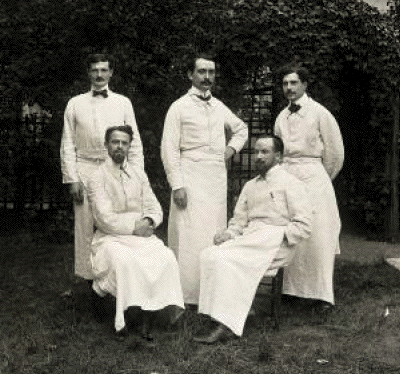 - Ch. Foix debout à droite,
interne à l'hôpital Broca en
1908
|


