Aim: There have been a few reports about 3-D
sonographic observation of fetal movements using
dynamic 3D sonography. However, dynamic 3-D
sonography is not real-time, the frame rate
being in the region of 4-6 frames per second
depending on the size of the region of interest
and the number of lines employed. Recently, a
new faster 3-D sonography, which acquires up to
28 frames per second, has become available.
Using this system, we studied a full range of
fetal facial expressions during pregnancy.
Methods: A total of 17 normal fetuses in 16
pregnancies (15 singletons and one twin) at
20-38 weeks' gestation was studied using a
transabdominal real-time 3-D ultrasound machine.
This 3-D ultrasound machine proved capable of
providing continuous 3-D sonographic images
every 0.05 and 0.035 s. The fetal face was
monitored for 15 min for each subject.
Results: Fetal eyelid movement (fetal
blinking) was observed in three of 17 fetuses
(17.6%). Double blinking was identified in one
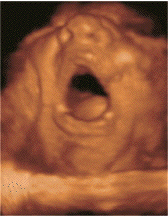
fetus at 38 weeks. Various types of mouth
movement (yawning, a little opening, chewing,
and subtle lip movement) could be observed in
nine of 17 fetuses (52.9%). In the course of
yawn-like opening of the mouth, tongue movements
such as tongue thrust and tongue click were
clearly shown in three fetuses (17.6%). A
lingula movement was also identified in the
course of tongue movement.
Conclusion: Real-time 3-D sonography
provides a novel means for evaluation of fetal
movement, particularly fetal facial expression,
in the second and third trimesters. Real-time
3-D sonography might be an important modality in
future fetal behavior research and in evaluation
of fetal well-being.
Introduction
There have been a few reports about 3-D
sonographic observation of fetal behavior (or
movement), particularly fetal facial expressions
using conventional dynamic 3-D sonography.1
However, at the moment, dynamic 3-D sonography
is not real-time, the frame rate being in the
region of 4-6 frames per second,
depending on the size of the region of
interest and the number of lines employed?
Recently, a new faster 3-D sonography, which
acquires up to 28 frames per second, has become
available. Therefore, the limitations of dynamic
3-D sonographic fetal imaging will now be
resolved. Using this real-time 3-D sonography,
we studied a full range of fetal facial
expression during the second and third
trimesters..................
Discussion
Behavior is a product of the functioning
central nervous system and hence, by studying
behavior, it is possible to make inferences
about the functioning of the brain. By observing
the behavior of the fetus, it is possible to
examine the functioning of the central nervous
system and brain and this provides, for the
first time in the fetus, a 'direct' means with
which to assess arguably the most important
organ we possess! Fetal behavioral studies as a
means of assessing fetal wellbeing have become
less fashionable in the past 10 years due to the
relative difficulty of studying a range of fetal
activities using 2-D scanning. The ease with
which real-time 3-D scanning can be used for
this purpose might well see a resurgence of
interest in fetal behavior and responsiveness.'
In addition to yawning, sucking and swallowing,
which have previously been described using 2-D
imaging, it is now feasible using dynamic 3-D
ultrasound to study a full range of facial
expressions, including smiling, crying, and
eyelid movement.',',' However, facial
expressions such as smiling and crying are
subjective impressions of the examiner.
Therefore, we only evaluated facial activities
such as fetal mouthing and blinking in our
study.
Among the facial activities observed using
dynamic 3-D sonography, simultaneous eyelid and
mouthing movements dominated between 30 and 33
weeks' gestation.' Pure mouth movements such as
mouth opening, tongue expulsion, yawning and
pouting were present, but at a significantly
lower rate. The scan repetition time of the
machine used in the study of Kurjak et al. was
2s. Therefore, rapid fetal facial movements,
including rapid blinking, subtle lip movement,
and dynamic lingual movement (movements
occurring in less than 2s) could not be shown
because of the relatively slow repetition time
for data acquisition to obtain a satisfactory
image. The frame rate of our machine was in the
region of up to 28 frames per second depending
on the size of the region of interest and the
number of lines employed. Using this machine, we
could carry out real-time 3-D observations of
fetal facial expressions.
In conclusion, real-time 3-D sonography
provides a novel means for evaluation of fetal
movement, particularly fetal facial expression,
in the second and third trimester of pregnancy.
Real-time 3-D sonography might be an important
modality in future fetal behavior research and
in the evaluation of fetal well-being. If we can
observe fetal behavior precisely using this new
machine, we can obtain new and/or additional
information for better diagnosis and
understanding of nonreassuring fetal status in
utero. Moreover, we might see unknown fetal
behavior functions that have not been detected
before. However, a limitation associated with
our new 3-D sonographic technique is the narrow
defined region of interest through a 20°
angle. This limitation of real-time 3-D
sonographic fetal imaging will be resolved as
further technical advances are made.
References
1. Kozuma S, Baba K, Okai T, Taketam Y.
Dynamic observation of the fetal face by
three-dimensional ultrasound. Ultrasound Obstet
Gynecol 1998; 13: 282-284.
2. Kuno A, Akiyama M, Yamashiro C, Tanaka H,
Yanagihara T, Hata T. Three-dimensional
sonographic assessment of fetal behavior in the
early second trimester of pregnancy. J
Ultrasound Med 2001; 20:1271-1275.
3. Campbell S. 4D, or not 4D: That is the
question. Ultrasound Obstet Gynecol 2002; 19:
1-4.
4. Azumendi G, Kuijak A. Three-dimensional
and fourdimensional sonography in the study of
the fetal face. Ultrasound Rev Obstet Gynecol
2003; 3: 160-169.
5. Kurjak A, Azumendi G, Vecek N et al.
Fetal hand movements and facial expression in
normal pregnancy studied by fourdimensional
sonography. J Perinat Med 2003; 31:
496-508.
6. Gill EA. Live three-dimensional echo - a
major incremental step in the development of
cardiac ultrasound. J Cardiovasc Manag 2003; 14:
13-17.