Qualitative and quantitative aspects of
fetal behaviour were studied in nine healthy
nulliparae during the second half of pregnancy.
Continuous real-time ultrasound observations of
60 min duration were carried-out at four-weekly
intervals from 20 to 36 weeks of gestation,
using two dynamically focussed linear array
transducers positioned lengthwise allowing
viewing of saggital sections through the entire
fetus. Various movement patterns were classified
according to de
Vries et al.
The reproducibility as expressed by the mean
standard deviation in the analysis of the
percentage incidence of the different movement
patterns was good (1.6 - 2.2%). Both the
incidence and percentage of observation time in
which general movements were present decreased
with advancing gestational age. Breathing
movements frequently occurred as an isolated
phenomenon; occasionally they were associated
with jaw movements, swallowing, hiccups or
general movements.
The incidence of breathing movements as well
as the percentage of observation time in which
breathing movements were present, demonstrated
an increase up to 32 weeks with a drop at 36
weeks of gestation. Hiccups occurred
episodically, following each other in regular
succession. Both the incidence and the
percentage of observation time in which hiccups
were present fluctuated widely.
Stretches and startles displayed a decrease
in incidence with advancing gestational age,
whilst eye movements showed an increase.
Rythmical jaw movements were often followed by
swallowing.
Occasionally, yawns or tongue movements
were seen. They may be combined with
breathing and general movements. The incidence
of jaw movements increased up to 28 weeks with a
decline after. Both brief and longer periods of
hand-face contacts were documented with wide
variation in incidence. Head rotations
frequently occurred as a single event; the
incidence showed a decrease up to 28 weeks
followed by an increase at 36 weeks of
gestation. The incidence of head retroflexion
varied widely with gestational age.
Jaw
movements
Qualitative aspects. There are several types
of specific movement patterns containing
movements of the jaw. Isolated jaw movements may
be slow or quick and their degree of jaw opening
is variable. Sucking, regular rhythmic jaw
movements at a rate of about 1-2 per second can
be observed. This pattern is often followed by
swallowing, indicating that the fetus is
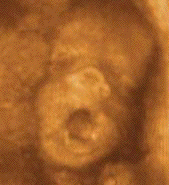
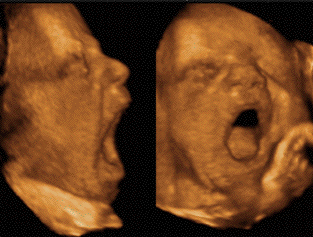
drinking amniotic fluid. A yawn can be
observed as a movement pattern identical to that
seen in infants, children and adults: slow
opening, prolonged wide opening of the jaws
followed by quick closure with simultaneous
retroflexion of the head and sometimes elevation
of the arms in exorotation. Incidentally,
tongue movements can be observed. Jaw movements
may be also combined with breathing movements,
hiccups and general movements.
Quantitative aspects. The incidence of any
kind of jaw movements expressed as median values
increased from 142 at 20 weeks to 305 at 28
weeks of gestation. After 28 weeks a decline in
median value was observed to 145 at 36 weeks of
gestation. The regresssion coefficients revealed
both negative and positive values; no
significant difference from zero of the median
value could be established.