- Tous
les articles consacrés au
bâillement
foetal
- Fetal
yawning: all
publications
-
- Video de
bâillement foetal à 23 semaines en
Echo 4D
- Video
de bâillement foetal à 13 semaines
en Echo 4D
-
- Fetal
yawning : a behavior's birth with 4D US
revealed
-
- INTRODUCTION The advent of real-time
ultrasonography has allowed the observation and
further characterization of several aspects of
behavior in the human fetus, including body
extremity movements, breathing movements,
stretches, startles, hiccups, eye movements, jaw
movements, sucking and swallowing, head to face
contact, and head rotation, anteflexion and
retroflexion.
- Fetal yawning, one of the most uncommon
behavioral, states in hurnan fetuses, can be
observed incidentally, during ultrasonographic
examination of the fetal face during the second
and third trimeisters. In this report, we
describe in detail a fetal yawning pattern in a
27-week fetus. This observation provides
chronological timing and expands previous
observations of this complex involuntary reflex
in utero.
-
 -
- CASE REPORT
- A 25-year-old woman underwent
ultrasonographic evaluation for fetal growth at
27 weeks because of uterine size and dates
discrepancy. High-resolution ultrasonographic
examination (Acuson 128XP/ 10, Acuson, CA)
revealed a single fetus in cephalic presentation
with biometry consistent with dates. There were
no fetal structurai anomalies, the amniotic
fluid was normal, and color Doppler examination
demonstrated normal impedance indices in both.
the umbilical and middle cerebral arteries.
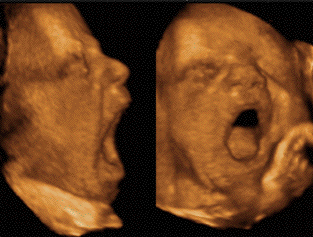
During focused examination of the face, the
fetus clearly yawned several times. Five yawning
movements in total, all similar to those seen in
infants, were observed over a 7-min period of
time.
-
- They consisted of a slight extension of the
head, followed by progressive and wide opening
of the mouth with simultaneous retraction of the
tongue, sustaining wide opening of the mouth for
a fraction of a second, and a return to the
resting position with closed mouth and flexed
head. All five complete sequences observed vere
taped in a video cassette recorder, model
AG-7/350 (Panasonic, Tokyo) and 2-D Cine Option
Display (Acuson) used for subsequent analysis of
timing. Each yawn lasted for 4-6 s, the
intervals between yawns being 138. 42, 195 and
21 s. Since we were imaging the fetal profile, a
simultaneous view of the upper extremities and
thoracoabdominal region was not possible and
therefore simultaneous stretching of the arms
and fetal breathing if present, were not
documented. At 38 weeks, an elective Cesarean
section was performed because of previous
Cesarean delivery, with delivery of a healthy
fernale infant weighing 2890 g with Apgar
scoresof 8 and 10 at 1 and 5 min, respectively,
and arterial and venous cord pH of 7.294 and
7.346 respectively. Follow-up to 2 months has
been normal.
-
- DISCUSSION
- Yawning is a universally well known, but
poorly understood, physiological reflex present
in almost all mammals, consisting of breathinig
through the mouth and nose with a long
inhalation with the mouth wide open, followed by
a slow exhalation. Although it can be induced by
several physiological processes, such as hunger,
fatigue, sleepiness, boredom and drowsiness, a
number of neurological disorders and drugs can
also trigger this reflex. The physiological
function and neuroanatomical pathways involved
in yawning are unknown. It is therefore not
surprising how little is known about this reflex
in the human fetus. According to de Vries and
coworkers and Roodenburg and colleagues isolated
episodes of fetal yawning can occasionally be
observed during both the first and the second
half of normal pregnancy, with the f irst
evidence at 11 weeks. It has also been shown
that in terrn human fetuses, yawning occurs
predominantly during the active sleep (2F) and
not during the quiet sleep (1F) behavioral
state. However, since fetal movements of the jaw
are far more common than yawns throughout
pregnancy, it is possible that some of the
movements. observed by these investigators might
have represented prolonged opening of the mouth
rather than yawning.
-
- Sherer and
associates described in detail a single
yawning movement in a 20 week fetus; they
observed that the fetal mouth, previously
closed,opened widely and remained so for 2 to 3
minutes'in association with simultaneous
extension of the fetal arms and flexion of the
fetal head. We cannot confirm their observation
regarding the duration of the yawn or the number
of yawns,since in our case several yawning
movements were seen and each individual sequence
was observed for only a very short period of
time, ranging from 4 to 6 s. A possible
explanation for repetitive yawning in our case
could be that the observation was made in a
transition between one behavioral state and
another, i.e. just before or after the active
sleep (2F). behavioral state, but this needs to
be proved. The physiological role of yawning
during intrauterine life remains speculative. It
has been proposed that yawning is a complex
arousal defence mechanism. the center of which
is located in the reticular brainstem, and its
function is to reverse brain hypoxia and improve
brain oxygenation. However, its role for only
primary respiratory purposes has been
questioned. In our case, fetal hypoxia was ruled
out by Doppler study. In addition, fetal fatigue
or boredom are highly unlikely.A respiratory
function is less probabble, since the
surrounding environment is liquid rather than
gaseous, as in the case of, extrauterine life.
However, since a forced inspiration is a
critical component of yawning, a potential role
for expanding fetal terminal alveoli by the
inspired fluid is possible consistent with the
hypothesis that yawning may serve as a mechanism
to protect against alveolar collapse in
extrauterine life.
|