- Introduction
- Qu'est-ce qu'un bâillement
- Bâiller : l'étymologie
- Quand bâillons-nous ?
- Interprétations historiques
- Nouvelles conceptions
- Phylogénèse
- Neurophysiologie du bâillement
- Schémas anatomiques, embryologie
- Sémiologie et examen clinique
- Complications manoeuvre de Nélaton
- L'excès de bâillements : des tics ?
- Bâillements et autres pathologies
- Bâillements iatrogènes
- Enquête en médecine générale
- Observations et cas cliniques
- Les mystères restant à éclaircir
- Bibliographie
- Visiter des sites sur le sommeil
- Visiter des sites médicaux et bibliothèques
- Index - plan du site
- Résumé - vulgarisation
- Les critères éthiques du site
- L'actualité du site
- L'auteur : Dr Walusinski
- Télécharger textes du site
- Recherche par thème
- Recherche par mot du site :
- S'inscrire à la lettre d'information sur le bâillement
- Du bâillement en littérature
- Le bâillement vu par les peintres

la thèse 
Les états neurasthéniques haut de page A functional neuroanatomy of tics in Tourette syndrome E Stern, D Silbersweig Arch Gene Psychiatry Aug 2000; vol 57; p741-748 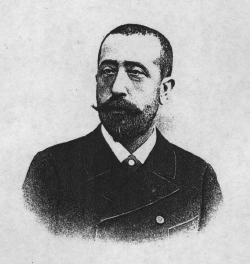
Biographies de neurologues Nouvelle Iconographie de La Salpêtrière L'histoire des neurosciences à La Pitié et à La Salpêtrière J Poirier The history of neurosciences at La Pitié and La Salpêtrière J Poirier
mise à jour du 24 septembre 2015 Nécrologie dans la Nle Iconographie de La Salpêtrière
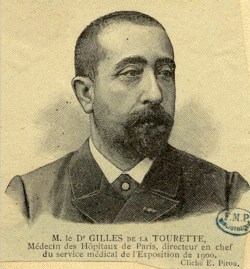
Georges Albert Brutus Édouard Gilles de la Tourette (1857 -1904) Contribution à l'étude des bâillements hystériques Nouvelle Iconographie de La Salpêtrière 1890 G. Gilles de la Tourette interne de JM. Charcot G. Gilles de la Tourette 1857-1904 in english Les biographies de neurologues
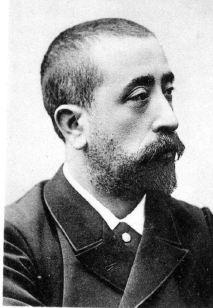
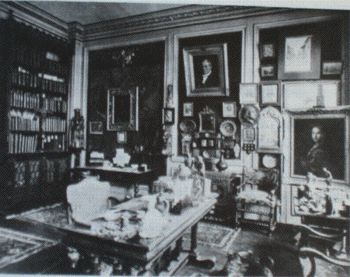
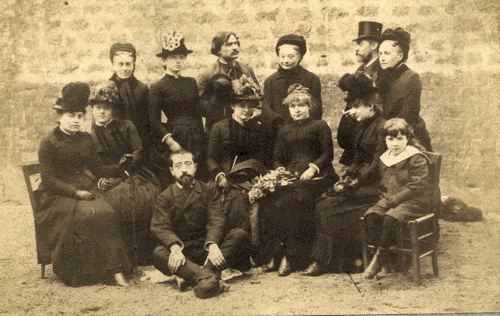
- Gilles de La Tourette ( c'est son nom) Georges Albert Brutus Edouard (ses prénoms) né à Saint-Gervais-les-Trois-Clochers (Vienne) en 1857 et décède à Lausanne (Suisse) en1904. Ci-dessus son domicile au 39 rue de l'Université Paris vers 1900.
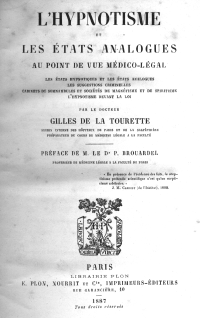
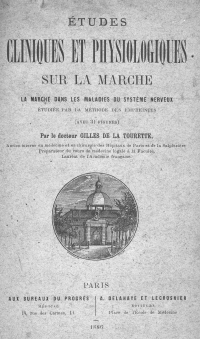
- Il fait ses études secondaires à Châtellerault, commence, à l'âge de 16 ans, ses études de médecine à l'école de médecine de Poitiers, puis les poursuit à Paris. Reçu à l'externat 195e/231 en 1878, à l'internat en 1881, il a pour maîtres successivement Désiré Simonet (1823-1884), Achille Gougenheim (1839-1901), François Damaschino (1840-1889), Jean-Martin Charcot (1825-1893) en 1884, et Paul Broaurdel (1837-1906) en 1885. Il est chef de clinique de 1887-1888 auprès de Charcot et son secrétaire en 1886-1887. Il soutient sa thèse le 28 décembre 1885 : "Etudes cliniques et physiologiques sur la marche".
- Gilles de la Tourette apparait au premier plan, ceint d'un tablier blanc sur la tableau d'André Brouillet (1857-914) une leçon à La Salpêtrière, peint alors qu'il est chef de clinique.
- En 1893 il est reçu médecin des hôpitaux à sa septième tentative. Après un échec en 1892, en 1895, il réussit au concours d'agrégation de médecine légale. Son nom reste attaché à un éponyme, le syndrome Gilles de la Tourette (SGT) qui lui a été donné par Charcot après sa description incomplète de la maladie en janvier 1885 dans les Archives de Neurologie. Charcot fera compléter la clinique psychiatrique du syndrome par son successeur Georges Guinon (1859-1932) en 1886.
- Il est choisi comme Médecin en chef de l'Exposition Universelle de 1900 à Paris. A partir des années 1895, il manifeste des troubles du comportement (mégélomanie notamment) qui vont obliger à son internement en 1901, en Suisse, à la Maison de santé du Bois de Cery, près de Lausanne où il meurt lors d'un état de mal convulsif le 22 mai 1904. Il ne fait aucun doute qu'il était affecté d'une paralysie générale d'étiologie syphilitique.
- Il publie de nombreux articles et livres consacrés à la neurologie et à la psychiatrie. Il écrit une biographie de Théophraste Renaudot en 1884 pendant son internat chez Charcot et, dans la collection La Bibliothèque Diabolique de Bourneville, Une Soeur Jeanne des Anges, avec Gabriel Legué en 1886. Sous le pseudonyme de Paracelse, Gilles de la Tourette a aussi collaboré au journal La Revue Hebdomadaire.
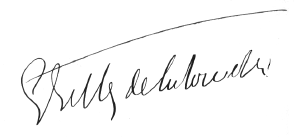
- La maladie de Gilles de la Tourette
- GE Gilles de la Tourette La maladie des tics convulsifs (pdf)
- Contribution à l'étude des bâillements hystériques Nouvelle Iconographie de La Salpêtrière1890
- Traité clinique et thérapeutique de l'hystérie d'après l'enseignement de La Salpêtrière1895
- Gilles de la Tourette par P. Legendre pdf
- Attentat contre Gilles de la Tourette 07/12/1893
- La nécrologie La Presse Médicale 4 juin 1904
- La nécrologie Nouvelle Iconographie de la Salpêtrière 1904
- The forgotten face of Gilles de la Tourette: practitioner, expert, and victim of criminal hypnotism at the Belle Époque Bogousslavsky J Walusinski O
- Criminal hypnotism at the Belle Époque : The path traced by Jean-Martin Charcot and Georges Gilles de la Tourette Bogousslavsky J Walusinski O Veyrunes D
- Correspondance inédite de G. Gilles de la Tourette, sa maladie fatale Walusinski O. Duncan G
- Correspondance inédite de G. Gilles de la Tourette avec JM. Charcot et G. Montorgueil Walusinski O. Duncan G
- Vivre ses écrits, l'exemple de G. Gilles de la Tourette Walusinski O. Duncan G
- Georges Gilles de la Tourette: The Man And His Times AJ Lees, Rev. Neurol. (Paris), 1986, 142, 11, 808-816
- Georges Albert Edouard Brutus Gilles de la Tourette (1857-1904), one of Charcots favourite pupils and his self-appointed amaneunsis made several valuable contributions to medicine and literature. His most substantial achievements were in the study of hysteria and the medico-legal ramifications of hypnotism, but he was also a competent neuropsychiatrist with a particular interest in therapeutics. He was a dynamic, passionately outspoken man whose prodigious literary output reflected his own restless compulsions as well as the interests of his beloved chiefs Brouardel and Charcot. His love of Loudun, his ancestral home strongly influenced his subject matter which included a biography of Theophraste Renaudot and with his colleague Gabriel Legue a perceptive analysis of Soeur Jeanne des Agnes' account of her hysterical illness induced by her unrequited love for the Loudun priest Urbain Grandier.
- In 1893 shortly after the tragic death of his young son and of his mentor Charcot, Gilles de la Tourette was shot by a deluded woman who had been a patient at the Salpetriere. Her claims that she had been hypnotised by Gilles de la Tourette against her will causing her to lose her sanity bore a macabre resemblance to the accusation of Soeur Jeanne des Agnes against Grandier. The bizarre episode became a "proces celebre" seeming superficially to vindicate the Nancy School's views that criminal suggestion was possible under hypnotism, a view Gilles de la Tourette had vehemently rejected. Despite his colorful life and varied achievements only an incomplete biographical account by his friend Paul le Gendre, a few informative obituaries and some caustic sketches by Leon Daudet exist.
- Georges Albert Édouard Brutus Gilles de la Tourette (1857-1904), un des élèves favoris de Charcot, a fourni une contribution intéressante à la médecine et à la littérature. Ses écrits ont été essentiellement consacrés à l'étude de l'hystérie et aux conséquences médico-légales de l'hypnotisme. ("L'hypnotisme et les états analogues" qui influença S Freund, auditeur de Charcot à l'époque) Pourtant, c'était aussi un neuro-psychiatre compétent ayant un intérêt particulier pour la thérapeutique. Chez cet homme dynamique et passionné, la production littéraire abondante résultait probablement de l'hyperactivité incessante, aussi bien que de l'intérêt de ses patrons bien-aimés, Brouardel et Charcot. Son amour pour Loudun, son lieu d'origine, a largement influencé son œuvre qui comprend une biographie de Théophraste Renaudot et, avec son collègue Gabriel Legué, une analyse du tableau hystérique de Sœur Jeanne des Anges, et de son amour non récompensé pour le prêtre Urbain Grandier.
- En 1893, peu après la fin tragique de son jeune fils et de son mentor Charcot, une de ses malades de la Salpêtrière lui tira une balle de révolver.(une gravure du Pays Illustré 1893 relatant la tentative de meurtre). Il y avait une macabre ressemblance entre les déclarations de cette femme qui prétendait avoir été hypnotisée par Gilles de la Tourette contre son gré et l'accusation de Sœur Jeanne des Anges contre Grandier. Il s'ensuivit un procès, resté célèbre, qui a été interprété, notamment par l'École de Nancy, comme une criminalité déclenchée par hypnotisme, une vue que Gilles de la Tourette rejeta de manière véhémente. Son ami, Paul Le Gendre a fourni quelques aperçus malheureusement incomplets de sa vie ; quelques histoires caustiques ont été rapportées par Léon Daudet. AJ Lees.
- Gilles de la Tourette's syndrome
- In 1884 Gilles de la Tourette, prompted by his mentor, Charcot, described nine patients who were affected with compulsive tics. One of these was the Marquise de Dampierre who had previously been reported in 1825 by Itard. This aristocratic lady lived as a recluse and "ticked and blasphemed", and the obituaries in the Paris newspapers quoted some of the more colourful details of her desciption. Gilles de la Tourette's syndrome
- In 1884 Gilles de la Tourette, prompted by his mentor, Charcot, described nine patients who were affected with compulsive tics. One of these was the Marquise de Dampierre who had previously been reported in 1825 by Itard. This aristocratic lady lived as a recluse and "ticked and blasphemed", and the obituaries in the Paris newspapers quoted some of the more colourful details of her desciption. Her disturbances began when she was seven years old, and persisted until her death at the age of 80 years, except for one year when she visited Switzerland and married.
- Charcot favoured the euphonic eponym of "Gilles de la Tourette" and this name was attached to the disorder. During the closing years of the 19th century it was well documented and extensively reported. However, from the turn of the century to the mid 1900's it was rarely reported. It had seemed to disappear, as interest was lost in this syndrome. In 1978 Shapiro and his colleagues published a comprehensive, multi-disciplinary monograph. Thereafter the Gilles de la Tourette's syndrome was accepted as a specific entity, although controversy has persisted regarding syndromic boundaries. It has been suggested that several historic figures might have been affected, including Prince Conde, a member of the French royal family and Dr. Samuel Johnson, the british diarist. Samuel Johnson is believed to have suffered from Gilles de la Tourette's syndrome. Some authors also think that Wolfgang Amadeus Mozart (1756-1791) had the syndrome, and that this explains his foul mouth and his love of nonsense words.
- GE Gilles de la Tourette was an individual of great talent, subject to overexcitement and extraordinary activity. He wrote books, research articles, communications, and historical papers in psychiatry and neurology, but was well versed and interested in an even wider range of subjects. Late in his life, a young paranoid woman who was confined to a mental hospital shot him three times while he was in a consulting room. One bullet hit him in the head, and although the bullet was easily removed, it was said he never fully recovered from his injury. Tourette suffered from episodes of depression and mania in his last years and died insane, most likely from syphilis. (Origins of Neuroscience Stanley Finger)
- Gilles de la Tourette was a co-founder of the Nouvelle iconographie de la Salpêtrière.
- Bibliography:
- Etudes cliniques et physiologiques sur la marche Paris 1886 Delahayre et Crosnier Ed
- L'hypnotisme et les états analogues au point de vue médico-légal. Paris, 1887; 2nd. edition. Paris 1889. This work is on the medico-legal aspects of hypnotism, magnetism, and spiritualism which, at the time, were at the height of their popularity.
- Traité clinique et thérapeutique de l'hystérie d'après l'enseignement de la Salpêtrière. Paris, 1891.
- Les états neurastheniques. Paris, 1898.
- Leçons de clinique thérapeutique sur les maladies du système nerveux. Paris, 1898.
- Les actualités médicales. Formes cliniques et traitement des myélites syphilitiques. Paris, 1899.
- La maladie des tics convulsifs. La semaine médicale, 1899, 19; 153-156.
- L. C. McHenry: Samuel Johnson's tics and gesticulations. Journal of Historical Medicine and Allied Sciences 1967, 22; 152-168.
- A.J. Lees: Georges Gilles de la Tourette: The Man And His Times. Revue neurologique, Paris, 1986, 142, 11: 808-816.
- Robert Rapley: A Case of Witchcraft : The Trial of Urbain Grandier. McGill Queens University Press. 296 pages. 1999
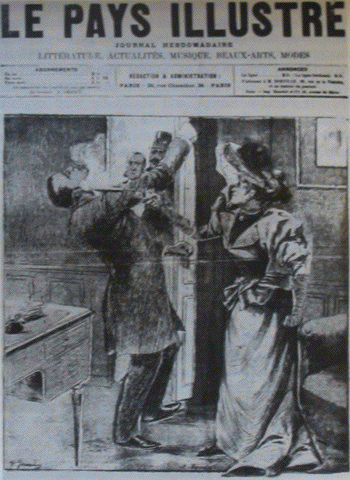
La tentative de meurtre de GE Gilles de la Tourette In english - Georges Albert Édouard Brutus Gilles de la Tourette French neurologist, born October 30, 1857, Saint-Gervais-les-Trois-Clochers near Poitou, département Vienne; died May 26, 1904, Lausanne, Switzerland.
- Associated eponyms: Beard's disease Obsolete term used for persons with unexplained exhaustion with abnormal fatigability - nervous exhaustion.
- Gilles de la Tourette's syndrome A rare psychoneurological disorder with onset in childhood, usually at the age of 7 to 10 years, characterised by echolalia, pallilalia and coprolalia, a want for touch, and stottering.
- Biography:
- Georges Albert Édouard Brutus Gilles de la Tourette was born into a medical family in Saint-Gervais-les-Trois-Clochers, a large village in Poitou, in west-central France. He commenced medical studies at Poitiers at the age of 16 years and subsequently moved to Paris.
- Gilles de la Tourette became externe in Paris 1879, doctor of medicine and preparator with Paul Camille Hippolyte Brouardel (1837-1906) 1885; 1893 médecin des hôpitaux; 1896 chef de service; 1900 professeur agrégé. He was one of Charcot's favourite pupils, his house physician and his self-appointed amanuensis. Charcot in turn helped his admiring pupil progressing steadily up the academic ladder. At this early phase of his life a contemporary described him as "a jovial and exuberant young man with a loud voice. Very ardent, but not very patient because over-excited, he got worked up in the most minor argument".
- Leon Daudet (1867-1942), medical student and friend of Charcot's son Jean, who subsequently became an explorer, encouraged Gilles de la Tourette at the Salpêtrière and described him as "ugly like a Papuan idol with bundles of hair stuck on it". Gilles de la Tourette had boundless energy and threw himself avidly into new therapeutic techniques such as suspension, vibration and hypnotherapy. Sigmund Freud attended Tourette's lectures during thie period and was possibly influenced by his work on hypnosis.
- In 1893 shortly after the tragic death of his young son and of his mentor Charcot, Gilles de la Tourette was shot in the head in his consulting rooms by a paranoid young woman who had been a patient at the Salpêtrière. She claimed that she had been hypnotised by Gilles de la Tourette against her will causing her to lose her sanity. The bizarre episode became a "proces celebre" seeming superficially to vindicate the Nancy School's views that criminal suggestion was possible under hypnotism, a view Gilles de la Tourette had vehemently rejected. Despite his colourful life and varied achievements only an incomplete biographical account by his friend Paul le Gendre, a few informative obituaries and some caustic sketches by LéonDaudet exist.
- Thereafter he fluctuated between depression and hypomania, his publications became incresingly strident and unconventional and he took to organising public lectures on literary and theatrical topics with himself as the major speaker.
- A talented teacher and a prolific writer, Gilles de la Tourette wrote and spoke publicly on a wide variety of topics, including art, literature and mesmerism. He respected neither persons nor conventions. He published an article on hysteria in the German Army, disregarding the wrath of Bismarck and later drew public attention to the deploring conditions on the british floating hospitals moored on the river Thames.
- Gilles de la Tourette's most substantial achievements were in the study of hysteria and the medico-legal ramifications of hypnotism, but he was also a competent neuropsychiatrist with a particular interest in therapeutics. He was a dynamic, passionately outspoken man whose prodigious literary output reflected his own restless compulsions as well as the interests of his beloved chiefs Brouardel and Charcot.
- His love of Loudun, his ancestral home strongly influenced his subject matter that included a biography of Theophraste Renaudot, physician, social service- administrator and founder of France's first newspaper, La Gazette (1631). With his colleague Gabriel Legue, Gilles de la Tourette made a perceptive analysis of Soeur Jeanne des Agnes' account of her hysterical illness induced by her unrequited love for the Loudun priest Urbain Grandier, who was burned on the stake for witchcraft. In 1902 Tourette's disturbed behaviour necessitated his removal from his professional post and he died in a mental hospital in Lausanne in June, 1904.
- Gilles de la Tourette's syndrome
- In 1884 Gilles de la Tourette, prompted by his mentor, Charcot, described nine patients who were affected with compulsive tics. One of these was the Marquise de Dampierre who had previously been reported in 1825 by Itard. This aristocratic lady lived as a recluse and "ticked and blasphemed", and the obituaries in the Paris newspapers quoted some of the more colourful details of her desciption. Gilles de la Tourette's syndrome.
- In 1884 Gilles de la Tourette, prompted by his mentor, Charcot, described nine patients who were affected with compulsive tics. One of these was the Marquise de Dampierre who had previously been reported in 1825 by Itard. This aristocratic lady lived as a recluse and "ticked and blasphemed", and the obituaries in the Paris newspapers quoted some of the more colourful details of her desciption. Her disturbances began when she was seven years old, and persisted until her death at the age of 80 years, except for one year when she visited Switzerland and married.
- Charcot favoured the euphonic eponym of "Gilles de la Tourette" and this name was attached to the disorder. During the closing years of the 19th century it was well documented and extensively reported. However, from the turn of the century to the mid 1900's it was rarely reported. It had seemed to disappear, as interest was lost in this syndrome. In 1978 Shapiro and
- his colleagues published a comprehensive, multi-disciplinary monograph. Thereafter the Gilles de la Tourette's syndrome was accepted as a specific entity, although controversy has persisted regarding syndromic boundaries.
- It has been suggested that several historic figures might have been affected, including Prince Conde, a member of the French royal family and Dr. Samuel Johnson, the british diarist. Samuel Johnson is believed to have suffered from Gilles de la Tourette's syndrome. Some authors also think that Wolfgang Amadeus Mozart (1756-1791) had the syndrome, and that this explains his foul mouth and his love of nonsense words.
- Gilles de la Tourette was a co-founder of the Nouvelle iconographie de la Salpêtrière. Charcot favoured the euphonic eponym of "Gilles de la Tourette" and this name was attached to the disorder. During the closing years of the 19th century it was well documented and extensively reported. However, from the turn of the century to the mid 1900's it was rarely reported. It had seemed to disappear, as interest was lost in this syndrome. In 1978 Shapiro and his colleagues published a comprehensive, multi-disciplinary monograph. Thereafter the Gilles de la Tourette's syndrome was accepted as a specific entity, although controversy has persisted regarding syndromic boundaries.
- It has been suggested that several historic figures might have been affected, including Prince Conde, a member of the French royal family and Dr. Samuel Johnson, the british diarist. Samuel Johnson is believed to have suffered from Gilles de la Tourette's syndrome. Some authors also think that Wolfgang Amadeus Mozart (1756-1791) had the syndrome, and that this explains his foul mouth and his love of nonsense words.
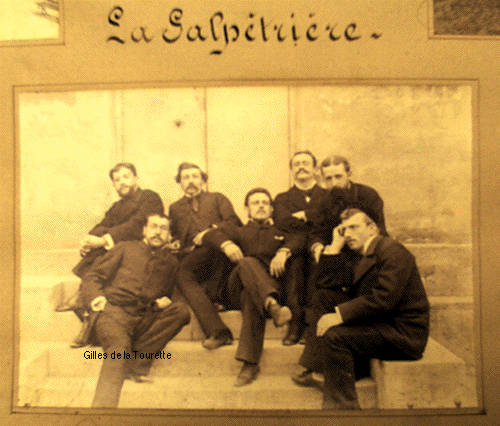
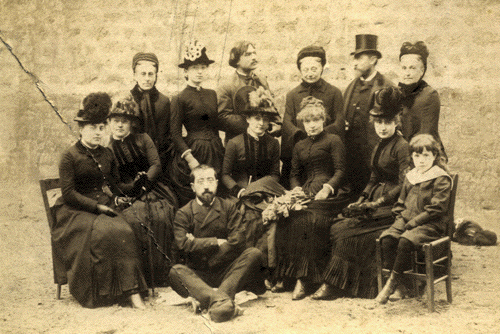
© Extrait de l'Album de l'internat de La Salpêtrière conservé à la Bibliothèque Charcot à l'hôpital de la Salpêtrière (Université Pierre et Marie Curie, Paris)
