resolutionmini


mise à jour du
27 juillet 2008
 
pdf de cet article
 
en français
Yawning : comparative study of knowledge and beliefs,
popular and medical
O. Walusinski, R. Meenakshisundaram
P. Thirumalaikolundusubramanian, S. Diwakar, G.Dhanalakshmi
Institute of Internal Medicine, Madras Medical College, Chennai, India
 
Knowledge, attitude and beliefs of medical residents on yawning

Chat-logomini

Abstract : Journal of Ethnobiology and Ethnomedicine submitted
 
Yawning and pandiculation are a universal behaviour amongst vertebrates, closer to an emotional stereotypy than a reflex. Phylogenetically ancient and ontogenetically primitive, they exteriorise homeostatic processes of systems controlling wakefulness, satiety and sexuality in the diencephalon. Western and Eastern cultures ascribe different meanings to these elements of non-verbal communication, closely related to empathy. We present a comparative study of popular and medical views on the subject, in France and India, revealing that perceptions of yawning are not very advanced, more closely resembling beliefs than scientific knowledge. Perhaps medical training will one day incorporate the study of this daily behaviour, common to all human beings.

Since Antiquity, yawning has held as little interest for philosophers, psychologists and physiologists, as it has for teachers, moralists and physicians. And yet, few things are as common as yawning. Everyone yawns 5 to 10 times a day. Yawning is a recognized behaviour in almost all vertebrates from birds to humans, one which starts in the womb and continues until death. Although yawning often procures a sense of well-being for the yawner, attempting to mask this behaviour is standard practice.
 
Modern neuroscience is still looking for a complete explanation of its intimate mechanisms. But above all, its exact physiological purpose remains a subject of debate; some see yawning as a mechanism for stimulating wakefulness [1], while others contest this view and instead link yawning to the effects of a homeostatic sleep factor accumulating throughout the waking hours [2].
 
In this paper, we offer a broad-based cultural and medical overview of the related conceptions and myths through comparison of the popular and medical views of Arabic, Western and Indian cultures. This will help us support the idea that yawning should be covered during medical studies, along with sleep and arousal disorders.
 
Beliefs
Arab countries
In 1923, Pierre Saintyves [3] surveyed cultural beliefs related to the meaning of yawning. According to Saintyves, Islam sees yawning as a sign of Satan entering the body, and sneezing as a sign of his leaving the body. Assas-bou-Malek and others all date this opinion back to the Prophet: "The Prophet said that Satan endeavours to distract the faithful in prayer. This is Allah's way of testing them. One way Satan distracts the faithful is by dominating their thoughts, infiltrating their minds during prayer. Another way is by making them yawn to divert attention away from their prayers. The Prophet told us that yawning is prompted by Satan and gave us the order to avoid it whenever possible. When it becomes inevitable, we must close our mouth with our hand."
 
We recently came across this question on a website: "I am a 22-year-old devout practising Muslim with a problem I hope to overcome with Allah's help and your advice. As soon as I begin my prayers, I start yawning involuntarily. And this continues even when I recite the Throne Verse. I really don't know why I'm yawning dozens of times, over and over, during a single prayer. I hope you can shed some light on my problem."
 
Saintyves also writes: "According to Ibn Battal, attributing yawning to Satan means he wants us to yawn and takes pleasure in it; he enjoys this disfiguring behaviour because it makes men look ridiculous." As to putting a hand over the mouth, this gesture applies when the mouth is already open, as well as when it is still closed, "because Satan enters…". Instead of the hand, a piece of clothing or any other object may be used. The fear of Satan entering the body is linked to the fear of possession, which explains why this gesture is demanded of the faithful during prayer [4]. W. Seuntjens call this idea : the demonic rationale of yawning etiquette [5]. Moroccans would place their hand in front of their gaping mouth because otherwise, it was belived, the devil would urinate into their mouth.
 
In India
In India, "bhuts" (spirits) are believed to prefer entering the body through the mouth. Yawning is therefore dangerous, because it entails two kinds of risks: either bhuts will penetrate the body through the throat, or a part of the soul might escape. Since it would be very difficult to recapture, the recommended practice is to put a hand in front of one's mouth and say "Narayan!" (Good God!), or snap one's fingers to scare the bad spirit away [3].
In Ancient Mayan civilization, yawning was thought to indicate subconscious sexual desires. In the same way, W. Seuntjens argues an hypothesis that yawning has an erotic side [5]. He found that both the "yawn" and the "stretch" of the stretch-yawn syndrome are semantically and etymologically associated with "desire" and "longing for". In several proverbs and sayings yawning, and especially contagious yawning, is interpreted as a clue of something more than just sympathy, that is, as a sign of being in love. Yawning was both linked with acedia-boredom and with luxuria (lechery) and passion. As a non-verbal behavior the yawn was found to figure in the courtship process. That this is not a purely recent or western phenomenon was illustrated by passages from ancient Indian literature [6].
 
In Europe
Around 590 AD, during the times of Pope Gregory the Great, a bubonic plague epidemic raged through Europe, decimating the population and inspiring numerous superstitions: "Yawning was fatal then, and the habit of signing the cross in front of the mouth originated during the times of the plague. [...] There was a plague they called inguinal, because a bubo appeared in the groins, causing men to die suddenly in the streets, in their houses, at play, during a meal. Their souls left their bodies when they sneezed or yawned. This is why we said 'God bless you' to those who sneezed. Those who yawned made the sign of the cross over their mouths" [5]. Even the sceptical Michel de Montaigne conced that he made the sign of the cross before his mouth while yawning, given evidence for the education's power. In Austria, in the case of a yawning baby who was not able to perform the sign of the cross, an older person would perform this gesture in front of the infant's mouth in order to prevent illness ans bad luck [5].
 
It is possible that the love of perfumes in the royal European courts in the 17th and 18th centuries had its origins in the necessity to conceal poor body hygiene. Placing one's hand in front of the mouth during yawning was helpful in hiding appalling oral conditions and reducing the expiration of nauseating odours. In a 2004 editorial for the British Medical Journal, G Dunea [7] was surprised to see medical students yawning frequently as they waited for their lecturer; moreover, 67.5% of the time they did not cover their mouths with their hands. He suggested this allowed students to avoid bacterial contamination of their palms, ironically adding that it is undoubtedly better to let others marvel at your tonsils than to risk injuring your elbow!
 
In medicine
In his treatise on wind, De flatibus liber, Hippocrates [8] noted that "the continual yawning of apoplectics proves that air is the cause of apoplexies", thereby confirming his theory that "wind is the cause of all diseases". In 1739, Hermann Boerhaave, in his Praelectiones academicae [9], explains that "yawning and pandiculation favour the equitable distribution of spiritus in all the muscles and unblock the vessels of which sleep or rest may have slowed the functions", and that their action fights "against the excessive pre-eminence of the flexor muscles and returns everything to its place". In his 1755 book De perspiratione insensibili, Johan de Gorter [10] was the first to describe yawning as accelerating blood flow, supposedly to improve the oxygenation of the brain, in response to cerebral anaemia. Well into the 20th century, there were regular references to this notion, even though it had never been demonstrated. Even someone as knowledgeable and inquisitive as JM Charcot repeated this maxim without any critical analysis in his Leçons du Mardi à la Salpêtrière in 1888. The inaccuracy of this hypothesis was formally shown by Provine, Tate and Geldmacher in 1987 [11]. They had their subjects inhale air with higher than normal levels of CO2 (3-5% vs. <0.5%). In response, the subjects' breathing rates increased, but they did not yawn. Likewise, when the subjects inhaled pure oxygen, there was no inhibition of spontaneous yawning at normal rates. Hence yawning is not a physiological reflex to improve cerebral oxygenation.
 
Phylogenesis, ontogenesis, ethology
The existence of yawning in reptiles confirms the primitive phylogenetic origins of this behaviour. Its survival without any notable evolutionary variations is an indication of its functional importance, as confirmed by its early ontogenetic manifestation. It coincides with the first type of sleep involving hypotonia, which evolves towards REM sleep between weeks 12 and 15 of pregnancy [12]. Ethology supports the idea that almost vertebrates yawn, whether heterotherms or homeotherms, whether herbivores, frugivores, insectivores or carnivores, whether they inhabit water, land or air. Probably giraffes, whales and dolphins do not yawn; the physiology of their sleep is not completely understood. It seems that they be lacking of durable REM sleep and their sleep occurs in one by one hemisphere.
 
Physiology
Living organisms, particularly vertebrates, exhibit varied behaviours which are essential to their survival and characterised by cyclical recurrence. This is the case for the three behaviours fundamental to life and its transmission: alertness (ability to survive predators while still needing to sleep to maintain brain homeostasis), feeding (energy capture) and sexuality (perpetuating life). Yawning and pandiculation are morphologically identical and apparently associated with each transitional state of the infradian, circadian and ultradian rhythms which characterise them. Rather than the result of a passive adaptation to environmental conditions, an animal's behavioural transitions are dictated by internal stimuli characteristic of homeostatic adaptations, generated in particular by the hypothalamus (suprachiasmatic nuclei, paraventricular nuclei). These internal biological clocks permit a precise balancing act between metabolic needs (satiety), survival of the species (copulation) and environmental conditions (tonic adaptation to weight and movement). Yawning and pandiculation are associated with transitions between wakefulness and sleep, occurring at the onset of hunger or satiety and with the ebb and flow of emotional states secondary to living in hierarchical social groups [13].
 
Yawning and pandiculation exteriorise the activity of the motor centres of the brainstem (V, VII, IX, X, XI, XII) and of the spinal cord, under the control of the hypothalamic paraventricular nucleus (PVN). The PVN is a point of integration between central and peripheral autonomic systems. Amongst other things, it plays a role in metabolic balance (osmolarity, energy), blood pressure and heart rate, and sexuality. Yawning and pandiculation can be triggered by injections (apomorphine, hypocretins, etc.) or inhibited after electrical lesion in the parvocellular zone of the PVN [14]. A group of oxytocin neurons situated in this zone and projecting to the hippocampus, the brainstem (locus ceruleus) and the spinal cord control yawning and erection. The stimulation of these neurons by dopamine or its agonists, such as excitatory amino acids (NMDA), histamine and oxytocin itself, triggers yawning and erection, whereas GABA and opioids have an inhibitory effect [15,16,17]. A specific role for the dopamine D3 receptor in this behavior has yet to be elucidated. Collins et al. report that dopamine D2/D3 agonists elicit dose-dependent yawning behavior in rats, resulting in an inverted U-shaped dose-response curve. The induction of yawning is a D3 receptor-mediated effect, whereas the inhibition of the yawning observed at higher doses is due to competing D2 receptor activity. [18].
 
Some thoughts on human pathology
On Tuesday, Oct.23, 1888, Jean-Martin Charcot presented, during one of his celebrated Tuesday gatherings at La Salpêtrière, the observation of a young woman inconvenienced by 8 yawns a minute, that is 480 per hour! He qualified this as a form of hysteria, despite his examination revealing binasal hemianopsia, right-side cheirobrachial skin insensitivity to all stimuli and, loss of smell. Given our contemporary knowledge (when a tumor has grown around the chiasma, it compresses the chiasma from both sides, thus mainly affecting the laterally located, uncressed fibers derived from the temporal halves of the two retinas, which are responsible for perception in the nasal hemifield of each eye), this points to a potential pituitary adenoma although he does not give any information on possible loss of the sense of smell and her menstrual status.
 
The disappearance of yawning may be due to an extrapyramidal syndrome, to the use of opioid drugs or high doses of caffeine, but is rarely a cause for complaint. The family-medicine practice shows that excessive yawning is a source of embarrassment in social circles.
 
There are multiple causes of excessive yawning, that is, a cluster of 10 to 30 yawns, many times a day. Of short duration, they may predict a vasovagal reaction or neurovegetative disorders (dyspepsia, migraine-like syndromes). All insults to the intra-cranial central nervous system or the hypothalamo-hypophyseal region may be involved: tumors with intracranial hypertension, infections, temporal epilepsy, strokes, etc [19,20,21].
 
For example, we coined the term "parakinesia brachialis oscitans"to describe cases of hemiplegia where the onset of yawning coincides with involuntary raising of the paralysed arm. We argued that a lesion in the internal capsule affecting an inhibitory pathway liberates certain subcortical structures that coordinate the massive inspiration of yawning and the motor control associated with quadrupedal locomotion [22]. The development of psychotropic drugs has given rise to a rich iatrogenic pathology: serotoninergic agents, apomorphine, acetylcholinesterase inhibitors, sismotherapy and, opiate withdrawal are triggers of yawn clusters. Excessive sleepiness with excess of yawns needs to search for an obstructive sleep apnea syndrom. Finally, after After ruling out the other causes, it seems possible to individualise a particular type of chronic motor tic disorder, associated with yawn clusters, and treated with haloperidol.
 
Current knowledge and beliefs about yawning
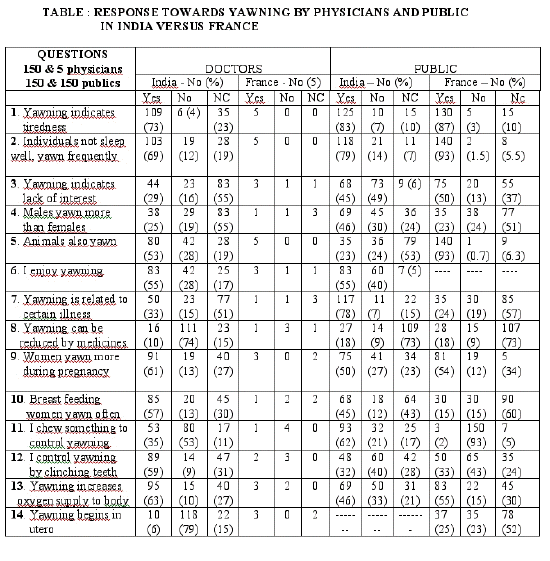
It is interesting to contrast current views of yawning held by the physicians in France and India, and then compare them to beliefs amongst the general French or Indian public. We have compared the data gathered in 1998 in France, partially published in a journal read by the French family physicians [23], and those of the present study in India. In France 150 patients of a private practice (public) were questioned during one week, whatever it may be the consulting cause and only 5 family physicians agreed to answer. In India, 150 anonymous questionnaire was distributed to rural population and doctors qualified in modern medicine and registered under Indian Medical Council were considered and requested to fill out all the questions (see table).
 
In all parts of the world, and regardless of the level of medical knowledge, yawning is associated with the idea of tiredness, boredom, and lack of sleep or non-restorative sleep. Due to their capacity to decode emotions expressed by behaviour and facial expressions, humans add an additional non-verbal meaning to the physiological role of yawning. In any culture, a yawning person sends the signal that he or she is bored and expresses lack of interest. Western culture associates an unfavourable connotation and lack of respect with this behaviour.
 
In France, women and men are considered to be yawn equally often; whereas in India, a larger proportion of the people questioned thought men yawned more often than women, which is incorrect [24].
 
Curiously, 24% of the laypeople and 28 % of the physicians, questioned in India, have doubted the existence of yawning in animals. The French, known for their close companionship with dogs and cats, did not have doubts about whether their pets yawned, but rarely knew that birds and fish yawn as well. Oddly, many of them thought that their yawning could trigger yawning in their dogs. On the contrary, yawning induced by echokinesis has only been found in great apes and humans, and appears to be species-specific. Modern neurophysiology explains this phenomenon as activity in the right parietal-temporal cortex, comparable to that observed during empathy [25]. Echokinesis thus seems impossible between canines and hominids. As such, anthropomorphism can be seen in this popular French belief [26].
 
All people reported appreciating the brief pleasure associated with a successful yawn. It is quite common for them to complain about unsatisfactory yawning when they don't experience the short period of relaxation that follows, like a moment of ecstasy. Relaxation and yoga techniques are well suited to bring about this state of harmony [27]. Strangely, 40% of the Indian laypeople questioned did not experience this sensation of well-being. 55% of public and doctors felt better after yawning. Paradoxically, 33% of the physicians reported they know that yawning could signal illness, versus 7% of the laypeople questioned. This paradox may be explained by the lack of knowledge released by the university. In France a majority of physicians appear unable to answer !.
 
Regardless of the continent, a large proportion of the physicians is unaware that medicine has the therapeutic to reduce the frequency and number of yawns, compared to a similar percentage of the general public without any opinion (74% versus 73%). Studies have shown that coffee reduces the number of yawns, as do neuroleptics, baclofen (GABAergic) and opioids.
 
Amongst both physicians and non-physicians, irrespective of culture, it is well known that women yawn more during pregnancy. This is explained by progesterone's modulation of D3 dopamine receptors in the PVN [28]. Indians also believe that breastfeeding women yawn more. This tendency is clearly explained by the crucial role of oxytocin in triggering a yawn, but the French tend not to notice it, perhaps because French mothers have regrettably lost interest in breastfeeding [28].
 
In India unlike in France, the general public prefer chewing something (ancestral practice advocated by Indian folk medicine) to try to avoid exteriorising a yawn, whereas physicians prefer clenching their teeth. Everyone knows that stretching or pandiculation favours yawning rather than preventing it.
 
In France as in india, amongst physicians as well as laypeople, the notion that yawning improves the supply of oxygen to the brain is widespread despite its inaccuracy, indicative of a belief without critical foundations, rather than validated scientific knowledge.
 
In France as in India, physicians still know little about yawning. The most conducive times for this behaviour &endash; upon waking, before sleep and when hungry &endash; are known. Likewise, the association of yawning with vasovagal events or hypoglycemia is relevant. Very few Indian or French practitioners evoke stimulation to explain the physiological role of yawning. There is little knowledge of iatrogenic causes, even though they most frequently explain excessive yawning, linked to serotonergic antidepressants [21,30]. There is little awareness of fetal yawning, which can be observed with ultrasound, despite the negative implications of its absence (delayed functional maturation in the brainstem, for example). Little is known about pathological yawning even though it is frequent during migraines, and in sleep apnoea, temporal lobe epilepsy, stroke, pituitary disorders, and in hyperactivity/attention deficit disorder.
 
Whether French or Indian, 100% of the physicians questioned said yawning was never discussed during their medical studies. Less than 5 hours are devoted to sleep in France during 8 year training period and only 2.5 hours in India of 5 year training period even though we spend a third of our lives in sleep. Yawning, a daily behaviour at every age, is not even considered!
 
The fact we know so little about this daily activity, which like any physiological behaviour has its own pathology, and the fact this ignorance is equally as common amongst physicians and laypeople can only be met with surprise. Moving away from folk knowledge, akin to believe in magic, and towards scientific understanding might require integrating the study of yawning into medical training.
 
yawning
Références
 
Argiolas A, Melis MR. The neuropharmacology of yawning. Eur J Pharmacol. 1998;343(1):1-16.
 
Argiolas A, Melis MR, Gessa GL. Yawning: neurochemistry; physiology and pathology. Cephalagia 1987;7(suppl 6):131-137.
 
Argiolas A; Gessa GL. Central functions of oxytocin. Neurosci Biobehav Rev 1991;15(2):217-231.
 
Boerhaave H. Praelectiones academicae in proprias institutiones rei medicae. 1741-1745 Gottingae. A. Vandenhoeck (imp.) 4 vol.
 
Bourgne N. Bâiller c'est quoi? Quel sens en yoga? Mémoire d'enseignant de yoga. Strasbourg (France). École Alsacienne de Yoga, 2006.
 
Cattaneo L, Cucurachi L, Chierici E, Pavesi G. Pathological yawning as a presenting symptom of brain stem ischaemia in two patients. J Neurol Neurosurg Psychiatry.2006;77(1):98-100.
 
Collins GT, Witkin JM, Newman AH, et al. Dopamine agonist-induced yawning in rats: a dopamine D3 receptor-mediated behavior. J Pharmacol Exp Ther. 2005;314(1):310-319.
 
de Gorter J. De perspiratione insensibili. Patavii. 1755. J. Manfrè. 328p.
 
De Las Cuevas C, Sanz EJ. Duloxetine-induced excessive disturbing and disabling yawning J Clin Psychopharmacol. 2007;27(1):106-107.
 
Dunea G. On covering one's mouth (when yawning). BMJ. 2004;328(7445):963.
 
Dureau de la Malle A. Mémoire sur le développement des facultés intellectuelles des animaux sauvages et domestiqués. Annales des Sciences Naturelles. 1831;21:388-419.
 
El Bokhâri. Les traditions islamiques (traduites de l'arabe avec notes et index par O. Houdes et W. Marçais). Paris. Imprimerie Nationale, 1903-1914. tome IV, 211-213.
 
Edsman CM Gähnen in Die Religion in Geschichte und Gegenwart. Galling K and Werbeck W, ed. Tübingen. Mohr. 1958. 7 vols (vol 2), 1186.
 
Goren JL, Friedman JH. Yawning as an aura for an L-dopa-induced "on" in Parkinson's disease. Neurology 1998;50(3):823.  
 
Guggisberg AG, Mathis J, Herrmann US, Hess CW. The functional relationship between yawning and vigilance. Behav Brain Res. 2007;179(1):159-166.
 
Hippocrate. Opera omnia. Anuce Foes Ed. Francfurt/Main. 1595. Wechel héritiers d'André. 379p. BIUM
 
Holmgren R, Holmgren B, Rodriguez R. Sex hormone influences on yawning behavior. Acta Neurobiol Exp 1980;40:515-519.
 
Kita I, Yoshida Y, Nishino S. An activation of parvocellular oxytocinergic neurons in the paraventricular nucleus in oxytocin-induced yawning and penile erection. Neurosci Res. 2006;54(4):269-275.
 
Le Camus A. La médecine pratique rendue plus simple, plus sûre et plus méthodique. Paris. 1769. Gagneau Lib. 477p.
 
Platek SM, Mohamed FB, Gallup GG Jr. Contagious yawning and the brain. Brain Res Cogn Brain Res. 2005;23:448-452.
 
Provine R.R., Tate B.C., Geldmacher L.L. Yawning: no effect of 3-5% CO2, 100% O2, and exercise. Behav Neural Biol. 1987;48:382-393.
 
Saintyves P. L'éternuement et le bâillement dans la magie, l'ethographie et le folklore médical. Paris. 1921. Emile Nourry Ed. 144p.
 
Sato-Suzuki I, Kita I, Oguri M, Arita H. Stereotyped yawning responses induced by electrical and chemical stimulation of paraventricular nucleus of the rat. J Neurophysiol. 1998;80(5):2765-2775.
 
 Seki Y, Sato-Suzuki I, et al Yawning/cortical activation induced by microinjection of histamine into the paraventricular nucleus of the rat. Behav Brain Res. 2002;134(1-2):75-82.`
 
Seuntjens W. On Yawning or the hiden sexuality of the human yawn. Thesis. Amsterdam 2004.Vrije Universiteit. 464p.
 
Schino G, Aureli F. Do men yawn more then women ? Ethol. sociobiol. 1989;10(5):375-378.
 
Sommet A, Desplas M, Lapeyre-Mestre M, Montastruc JL. Drug-induced yawning: A review of the french pharmacovigilance database. The French Network of Pharmacovigilance Centers. Drug Saf. 2007;30(4):327-331.
 
Vâtsyâyana M. Kâmasûtra. Translation from Sanskrit W Doniger, S Kakar. Paris 2007. Le Seuil 430p.
 
Walusinski O. Pourquoi bâillons-nous ? A propos d'une enquête en médecine générale. Rev Prat Med Gén. 2000;14(487):259-263.
 
Walusinski O, Deputte BL. Le bâillement: phylogenèse, éthologie, nosogénie. Rev Neurol (Paris). 2004;160(11):1011-1021.
 
Walusinski O, Kurjak A, Andonotopo W, Azumendi G. Fetal yawning assessed by 3D and 4D sonography. The Ultrasound Rev Obs Gyncecol. 2005;5(3):210-217.
 
Walusinski O, Quoirin E, Neau JP. Parakinesia brachialis oscitans. Rev Neurol (Paris). 2005;161(2):193-200.
 
Walusinski O. Yawning: Unsuspected avenue for a better understanding of arousal and interoception. Med Hypotheses. 2006;67(1):6-1
 
disguise