Introduction : Automatic-voluntary
dissociation of orofaciolingual-pharyngeal
motility is one of the hallmarks of the
biopercular Foix-Chavany-Marie syndrome. While
automatic-voluntary dissociation of movements of
the upper extremities (mostly apraxias) or
eyelid movements is well known, similar deficits
of other cranial movements have been reported
but less well studied. Apraxia is defined as the
inability to perform correctly voluntary learned
skilled movements upon request in an
experimental setting or everyday life (anterior
of frontal apraxia), to pantomime (posterior or
parietal apraxia), to use objects (on command,
imitation or presentation) or to imitate
correctly meaningful or meaningless gestures
performed by the examiner.
Apraxia can result from lesions of the
dorsolateral frontoparietal-subcortical circuits
interrupting the flow of information at any
level between the complex motor programs of the
frontal cortical areas and the sensorimotor
areas allowing external cues to guide motor
behavior. Unfortunately, the definition of
apraxia has been extended for apraxia of eyelid
opening to a syndromic entity of. In the
Foix- Chavany-Marie syndrome, or
biopercular syndrome, pseudo-bulbar palsy with
central voluntary palsy is reported, preserving
automatic and emotional movements. Multiple
brain infarcts are not infrequent and may
constitute a unique opportunity to study brain
function. We happened to observe a patient with
Foix-Chavany-Marie syndrome with a previous
unilateral pontine infarct which only preserved
the jaw reflex but not emotional movements of
the lower face or glossopharyngeal
reflexes.
Patient Report
A 71-year-old hypertensive patient with
multifocal vascular disease (ischemic
cardiopathy, vascular claudication of the legs)
and intermittent atrial fibrillation had a
history of left pontine infarcts in September
1985. He complained of acute rotatory vertigo
and bifrontal headache, and physical examination
revealed gait ataxia, left myosis, bilateral
gaze-evoked nystagmus, oculomotor ataxia and
right spastic sensorimotor deficit. A brain CT
was normal except for mild generalized atrophy.
Fifteen days later, he suffered from a left
sylvian opercular syndrome with right
faciobrachial spastic hemiparesis, Broca aphasia
and worsening of the right hemiparesis. He
recovered with severe dysarthria, a plegic right
arm and a stiff right leg, but was able to walk
with a cane during the following months.
In September 1994, he was rehospitalized for
an acute left motor hemiparesis, anarthria,
transient conjugate gaze and head deviation to
the right and a pseudobulbar syndrome without
emotional lability or spasmodic laughing or
crying. On physical examination he was slightly
drowsy, oriented, and with Cheynes-Stokes
respiratory pattern. He had lower face diplegia,
severe corticobulbar syndrome with spastic
plegia of jaw, trismus, clonic jaw reflex,
absent voluntary movements of the tongue,
anarthria (aphemia), dysphagia, aphonia, absent
gag reflex, bilateral paresis of
sternocleidomastoid and trapezius muscles.
Orolingual masticatory apraxia could not be
tested because of this important paresis, but
upper face motility (lids, frontal and eye
movements and praxias) were normal but slow. He
understood and executed simple and complex
orders. We could not see any emotional movements
of the lower face.
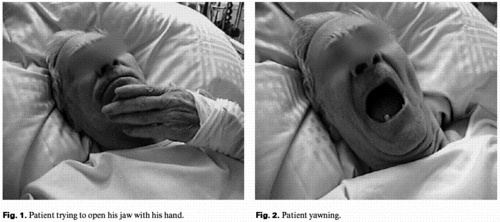
On detailed examination of jaw movement, he
could not open or close the jaw on order and
needed to help himself with his hand in order to
open or close his mouth. When asked to do so,
despite strenuous attempts of synkinesia, such
as opening of the eyelids, contracting the
frontalis muscle, or through movements of the
eyes, or retraction of the head backwards, his
mouth remained shut. Similarly, he was also
totally unable to cough on command. However, the
patient was found on several occasions with his
mouth wide open and movements of the inferior
facial muscles when yawning.
Reflex attempts of chewing movements (with
decreased amplitude and bulging of the lips) to
objects introduced into the mouth, such a straw
or a spoon, could be observed, but no
deglutition or phonation. Brainstem pontine
reflexes such as cochleopalpebral,
vestibulo-ocular, and horizontal oculocephalic
reflexes, upper face mimicking pain to nose
pinprick, corneal reflex and jaw reflex (which
was clonic) were all preserved in the upper face
only. Bulbar reflexes such as coughing,
swallowing, gag reflex and reflex phonation to
pain were abolished. Similarly, he was also
totally unable to cough, shout or breathe on
command. There was a spastic and hyperreflexic
asymmetric tetraparesis with a right algotactile
hemisensory deficit, with hand and foot clonus
and bilateral Babinski signs. A brain CT and MRI
with angio-MRI showed an acute right superficial
opercular and parietal sylvian infarct, an old
contralateral left insular and opercular lesion
corresponding to the second stroke and an old
left pontine infarct corresponding to the first
stroke and small subcortical white matter
lesions. MRI angiogram was unremarkable as well
as Doppler ultrasound examination of neck and
brain vessels. The strokes probably had a
cardioembolic origin.
Discussion
Our patient presented with a biopercular
Foix-Chavany-Marie syndrome and a unilateral
pontine lesion with disappearance of normally
preserved automatic-emotional/voluntary reflex
activity of the lower face, pharynx, larynx and
tongue, except for reflex jaw movement.
Initiation and control of mandibular
movements are processed by neural pathways
descending from the lateral sensorimotor facial
cortical area via direct and indirect
connections, facilitating motoneurones of jaw
opening and suppressing excitability of jaw
closing motoneurones of the trigeminal motor
nucleus.
The roles of the supplementary motor area,
premotor cortex, the cingulate motor area as
well as parietal areas and cerebellum have been
studied in detail with PET scan and fMRI for
movements of the hand, but have so far not been
demonstrated for facial and branchial motor
muscle groups.
Electrophysiological studies in monkeys
showed that corticobulbar neurons are localized
in the precentral gyrus and anterior bank of the
central sulcus with direct projections to the
brainstem. The activity of 75% of the neurons in
the jaw movement area was related to opening of
the jaw, keeping the jaw open or lateral
movements, whereas very few were related to
closing movements. Closing of the jaw and
rhythmic masticatory movements are probably
processed at the segmental level of the
brainstem (except for graded or tonic biting),
as well as their initiation and ending and the
complex coordination of tongue and jaw muscles
necessary to chew complex foods, positioning the
food bolus, preventing biting lesions or
coordinating highly complex speech
movements.
In humans, transcranial magnetic stimulation
of the masseter has been possible, which is
compatible with a separate tract from pyramidal
fibers. A massive bilateral representation is
reported, so that only bilateral lesions are
followed by significant deficits in jaw and
tongue movements. In contrast to the voluntary
motor control of the jaw, most of the reflex jaw
movements for mastication, yawning,
swallowing and speaking are thought to originate
in brainstem pontine motor nuclei and reticular
formation.
Our patient had bilaterally
cortical-subcortical lesions near the operculum
and insula, disconnecting those areas from the
supplementary motor area, premotor and
precentral sensorimotor cortical areas,
disrupting the highest-level voluntary motor
command of the jaw for voluntary jaw opening and
closing, but preserving pontine automatic
brainstem reflexes despite a previous unilateral
brainstem lesion.
This is a unique situation that
interestingly demonstrates that a unilateral
pontine lesion, in the presence of biopercular
suprasegmental lesions, is not sufficient to
make the reflex jaw movement disappear, but may
require bilateral pontine lesions, probably
because of a bilateral representation of
intersegmental brachial reticular reflexes.
In conclusion, our patient represents a
unique case of an isolated preservation of an
automatic-voluntary dissociation of jaw movement
in the presence of a unilateral pontine lesion,
which sheds some light onto the brain network of
jaw movements in humans.
Alajouanine,
et al Le Syndrome operculaire
unilatéral avec atteinte
controlatérale du territoire des V, VII,
IX, XI, XIIe nerfs craniens.
Rev. Neurol.1959; 101;
168-171
Alajouanine
T, Thurel R La diplegie faciale
cérébraIe (forme corticale de la
paralysie pseudo-bulbaire). Rev.
Neurol.1932; 38; 516-517
Pertuiset B, F
Perrier Le syndrome operculaire
unilatéral (rolandique inférieur)
d'origine vasculaire Rev Neurol
1960; 103; 63-64
Boudin
G, B Pépin, JP Wiart Le syndrome
operculaire unilatéral d'origine
vasculaire Rev Neurol 1960; 103;
65
Gschwend J
yawning in a case with transsecting glioma of
the pons Fortschr. Neurol.
Psychiat 1977; 45; 652-655
Crumley
RL The opercular syndrome - diagnostic trap
in facial paralysis The
laryngoscope 1979; 89; 361-365
Bauer G et al
Involuntary motor phenomena in the locked-in
syndrome J. Neurol. 1980; 223;
191-198
Bauer
G et al stimulus evoked oral automatismsin
the locked-in syndrome Arch
Neurol1982; 39; 435-436
Laurent-Vannier
A Syndrome de Foix Chavany Marie d'origine
traumatique Rev Neurol 1999;
155; 5; 387-390
Ghika J, et
al Dissociated preservation of
automatic-voluntary jaw movements in a patient
with biopercular and unilateral pontine infarcts
Eur Neurol 2003, 50;
185-188
Abercrombie
J, Gendrin A Des maladies de
l'encéphale et de la moelle
épinière Germer-Baillière
1835
Abercrombie
J Yawning and apoplexy Medical Times and
Gazette 1863;1:656-661
Bauer G. et al
Involuntary motor phenomena in the locked in
syndrome J Neurology 1980;223;:91-198
Bertolotti
M. Etude sur la pandiculation automatique
des hémiplégiques Rev Neurol
1905;2(19): 953-959
de
Buck Classification des mouvements anormaux
associés à
l'hémiplégie Rev Neurol
1899;6:361-365
Furtado D.
Provocation spinale d'un réflexe de
bâillement. Rev d'oto neuro
ophtalmologie.1951;23(1):
Ghika J.,
Bogousslavsky J. Dissociated preservation of
automatic-voluntary jaw movements in a patient
with biopercular and unilateral pontine infarcts
Eur Neurol 2003;50:185-188
Heusner A P
Yawning and associated phenomena Physiological
Review 1946;25:156-168
Lanari A.,
Delbono O. The yawning and stretching sign
in hemiplegics Medicina (B Aires)
1983;43(3):355-35
Liecey Nouvelle
observation de bâillement convulsif
périodique Le Courrier Médical
1879;29;334-336
Liégey
Deux observations de bâillements
intermittents Gazette médicale de
Strasbourg 1851; p118-119
Louwerse
E Forced yawning as a pseudobulbar sign in
amyotrophic lateral sclerosis J Neuroscience
Research 1998, sup, 392
Mulley G.
Assoctiated reactions in the hemiplegic arm
Scand J Rehab Med 1982;14:117-120
Ogle
JW. Arm rising during yawning The Medical
Times and Gazette. 28 february 1863 p 213
Pierre
Marie La Pratique Neurologique
Hémiplégie, mouvements
associés Masson 1911, p477-480
Pierre
Marie et Léri A. Mouvements
involontaires dans les membres paralysés
1911 Nouveau Traité de médecine et
de thérapeutique Brouardel, Gilbert,
Thoinot JB Baillière Ed 1911
p283-291
Quoirin
E. Elévation involontaire du membre
supérieur chez
l'hémiplégique lors d'un
bâillement Thèse doctorat en
médecine Poitiers 2002
Thomson HC
Associated movements in hemiplegia : their
origin and physiological significance Brain
1903;26:515-523
Töpper
R, Mull M, Nacimento W Involuntary
stretching during yawning in patients with
pyramidal tract lesions: further evidence for
the existence of an independent emotional motor
system European J Neurology 2003;10:495-499
Trautmann R.
Le bâillement Thèse Bordeaux;
1901-02; N° 40; 86 pages
Vulpian
A Leçons sur la physiologie
générale et comparée du
système nerveux faites au Museum
d'histoire naturelle. Rédigées par
E.Brémond. Paris, Baillière,
1866
Vulpian
A Maladies du système nerveux Paris,
Doin, 1879
Walshe FMR
On certain tonic or postural reflexes in
hemiplegia with special reference to the so
called "associated movements". Brain,
1923;46:1-37
Wimalaratna
HS, Capildeo R. Is yawning a brainstem
phenomenon ? a stroke patient who stretched his
hemiplegic arm during yawning Lancet
1988;1(8580):300